Showing posts with label Mexico. Show all posts

Monday, June 20, 2011

Take a Swing!

I was in my twenties before I was even able to conceive of the idea of a birthday party without a piñata. The idea that one could even have a celebration WITHOUT a papier-mâché animal or cartoon character was completely unthinkable to me. It was my brother who told me about this inexplicable horror. He had been seeing a young lady from Orange County who was of Scandinavian descent and this aberration of nature said that she’d only once had a piñata at Mexican themed birthday party. Nonplussed I simply stared at her. She may as well have told me that she had webbed toes. Keep in mind this is the same young woman whose family was also blissfully unaware that torillas are supposed to be warmed up before serving. For those of you who are only supposedly Mexican and do not have guac and beans running through your veins, piñatas are a mainstay of birthday parties. Like cake, ice cream, gifts, and a drunk uncle surrounded by empty cans of Bud Light, it is one of those items that without it, it simply isn’t a real birthday party.

Would you believe me if I told you that we have the Chinese to thank for the piñata? I don’t mean the Chinese working in the Toy District of Downtown Los Angeles, I mean the actual people of China! I wouldn’t have believed it either but it turns out that the people who brought us fireworks, Mao, delicious takeout, and the 2008 Olympics also gave us the gift of the piñata. According to Marco Polo (not just a fun game to play in the pool, my friends), the Chinese fashioned paper ox, cows, and buffalo, and filled them with different kinds of seeds. They were broken apart with different colored sticks and this was usually done in celebration of the New Year in hopes of bringing about a bountiful growing season. Along with silk, spices, and pasta, Mr. Polo brought back his writings which include this idea of the piñata which, in Italy, is referred to as a pignatta. By the 1300s the piñata was incorporated into Lent and, because Christianity had spread all over Europe, it is no surprise that this included Spain and by extension would reach the New World.

To say that all the credit goes to the Chinese and Europeans would be misleading. The ancient Mexicans did have similar concepts for quite a while before the Europeans arrived. It is the Mayans we can thank for the concept of blindfolding the participant before they take a whack at the piñata. If America’s Funniest Home Videos had been around back then we could have crotch shots on record going back over 1000 years. The Aztecs also had a tradition of honoring the god Huitzilopochtli, the god of the sun and war (think the Aztec Apollo), with clay pots filled with all sorts of goodies by laying them at the altar and then smashing them. I don’t really get it either but I suppose someday people will look back and wonder why I would eat cookies and wine every Sunday morning. Speaking of which, once the Europeans arrived they wanted to spread Christianity and did so by appropriating many of the native celebrations into Christian ones. Around the world most of the pagan religions revolve around the seasons and nature and in order to persuade people to convert they would give them a way to mingle the religions to the point where they could be celebrating two things at once. This is why we have All Saints Day at the end of the Harvest and Lent and Easter at the start of the growing season.

Over the years the piñatas did take on multiple specific Christian connotations. Everything from the seven deadly sins to man’s eternal struggle with temptation (I know, what?), stepping up to swing a bat a paper Optimus Prime full of candy was an entire Sunday School lesson. Needless to say, those days are long gone. In Mexico the busiest time for piñata makers is during the month of December for the Posadas, the nine days of celebration leading up to Christmas. In America it’s all about the birthday parties and celebrations of Cinco de Mayo.

My family has had them for every possible celebration- anniversaries, Fourth of July, Christmas, you name it. As you get older you are kind of forced to outgrow the piñata. This is never your own choice but the result of Mexican families being so big and everyone having so many damn kids. The ideal piñata age to be is about 10-13 years old. When you’re the youngest around you get the first swing but you’re not strong enough to do any real damage. Too old and you’re way at the back of the line and you’ll be lucky if you even get to take a swing. By the time you hit your late teens and you’ve got just the right amount of angst and hormonal frustration where beating a paper Ninja Turtle would be the best thing for you, you’re too big and too old to do it. And you probably have braces so you can’t enjoy the candy either so you just go to your room, pull down the shades, listen to some Nine Inch Nails and throw The Crow into the VCR. Ah, to be young again…

See that girl all the way over on the right? She probably never got to take a swing

So there you have it, your history of the piñata. Also, for those of you playing Words with Friends, Huitzilopochtli will earn you something like ten thousand points.

Wednesday, June 15, 2011

What's In A Name?

Latino. Hispanic. Chicano. Spanish.


When people ask me what I am I typically say American. It usually begs a follow-up or clarifying question as to my background or ethnicity and I’ll let them know that my family hails from Mexico. Though it’s not a terribly important debate in political philosophy I think hyphens are a little silly and are very misleading. After all exactly what would make someone Mexican-American? Could someone be termed American-Mexican? And how Mexican does one have to be in order to be called both Mexican and American? And how far back to we go with ethnicity or cultural background? Mexico has plenty of people descending from natives to the land. The people were invaded or mixed with nearly every country in Western Europe, most notably the Spanish whose land was at different times dominated by Jewish people, the Romans, and the Moors. Does that also make me part African-American? The hyphens are silly and do little to accurately represent ones cultural background.


Getting away from the hyphens we have all of these other names with which to designate ourselves. Spanish seems like an odd one. Here in New York it’s the one I hear most often. “What’s his background,” someone may ask when referring to me or someone with a similar family history. “He’s Spanish,” is often the reply. I’m about as Spanish as Gary Busey is sane- it’s a place I’ve visited and perhaps share some ancient connection to it but it does little to accurately describe anything about me. Around these parts Puerto Ricans, Dominicans, Cubans, they’ll all be referred to as Spanish. That would be correct if the question was about which language they speak but not about their background. Not really, anyway. I would hardly refer to George Clooney as “that English guy.” Bill Gates isn’t considered British. And Fernando Valenzuela is not Spanish. Javier Bardem, that guy is Spanish. Julio Iglesias, also Spanish. Antonio Banderas, that guy is Spanish as well. Me? Not so much. Obviously it’s easier to say Spanish than go through the litany of possible countries from which a Spanish speaker could hail, but we do have other words which we have agreed upon for such designations.


There is Chicano. I’ve found several stories detailing the etymology of the term but the one that appears the most is that it is a shorthand way of saying Mexicano and specifically refers to people of Mexican descent. The way I hear it, “Mexicano” was shortened to “Xicano” and since no one really knows what sound the letter X is supposed to make (is it a Z? An H? does it sound like KS), people agreed upon the CH sound. Some say it was primarily used as a derogatory term but I think it was used more out of naiveté or ignorance. This was around the time words like “negro” and “colored” were being used and while it would be terribly insensitive to use these words today political correctness and cultural sensitivity were not what they are today. Calling someone Chicano was the label for the children of Mexican immigrants and it was chosen and it became a way to label someone in the simplest of terms. In any event the term took on a negative connotation but eventually came to be embraced and used for a political movement. The Chicano Movement has its roots in the mid 1800s but didn’t really gain traction until the 1950s and 60s. It’s a fascinating time and I will address it in a future post but for now we’ll have to move on. Having grown up in the 80s and 90s, just a little bit after a great era of political and cultural awareness, I personally never associated the label of Chicano with a political movement. It was just another way people referred to people like me.


The terms Hispanic and Latino are often used interchangeably but don’t always mean the same thing. “Hispanic” as a word has its history going back to both the Greek and Roman Empires where the root word was used to describe the Iberian Peninsula, the area that comprises Spain, Portugal, Andorra and part of France. It eventually became the Latin word for Spain. As such, groups that have a primarily Spanish ancestry or influence are Hispanic but aren’t Latino unless they are also part of Latin America. It is thought that Latino was originally intended to refer to someone of Latin American ancestry. Thus it is accurate to consider a Mexican either Hispanic or Latino but someone from Spain can only be Hispanic. Either way I don’t see the need to split hairs as neither term is considered descriptive of race or specific ethnicity or background. When it comes to filling out that census information, in the eyes of the government I think I’m considered white. And let me tell you, I have some cousins who look anything but white.


So is there a term that is more correct than others? Do I have a preference? Not really. I’ve heard all of the derogatory terms thrown around, too. I’ve been called a beaner and spic (though I had no idea what a spic was at the time- I’m still a little fuzzy about it). I’ve been called a wet-back. It’s extremely rare that I have heard those terms and when I do it does not make the person saying them any more powerful or vicious; if anything it makes them sound outdated or anachronistic. Those words carry very little weight because I think that mine is a culture that gives very little power to terms for which we have no use. It isn’t a matter of reclaiming pejoratives and making them our own because we don’t want or need those words. They’re silly and to use them, trying to give new meaning to them, would be a waste of effort because it would only give attention to the intended insult. But getting back to the terms like Spanish, Hispanic, Latino, or Chicano… As I stated above I think Spanish is really inaccurate. As for the others, I guess any of them will do if a label is necessary. Personally I prefer to go by Eric.

Wednesday, June 8, 2011

The Tortilla

I’ve said it before and I’ll say it again, a flour tortilla with butter is probably the best snack ever. I have held this opinion for as long as I can remember. Sure I’ve had grilled cheese sandwiches and milk and cookies, I’ve indulged in cheese and crackers or apple slices, but for me nothing tops a flour tortilla with butter. It’s simple and delicious and amazing. All it takes is a few moments on the burner until you get just the right amount of crispy, flakey, texture- you can use a microwave in a pinch but it isn’t as good, smear some butter across that round, heavenly circle of flatbread that I can only liken to the manna of the Old Testament, roll it up and be sure to fold up the bottom end so the butter doesn’t drip on to the floor. There it is. A few moments of sublime satisfaction.

Tortillas and Mexican food are inextricable. Like rice with Japanese food, bread with American cuisine, and debt with President Obama, some things are always going to go hand in hand. These delectable disks of delicious dough derived from the kitchens of heaven have a long and stories history which can be found at the Mission Tortilla Factory at Disney’s California Adventure (sponsored by Mission Foods!) but if you haven’t got an extra hundred bucks for Disneyland and you don’t live in California you can get all of this rich and wonderful history for free here at ImSupposedToBeMexican.com because I love you so much. Tell your friends!

Growing up I always had flower tortillas more often than corn tortillas. Corn tortillas were around and they seemed to be preferred by my grandfather. The more durable texture of the corn tortilla seems to be more suitable for scooping up pinto beans and smearing with sour cream or guacamole whereas flour tortillas are better for wrapping up larger quantities of food as in a burrito or enchiladas. Of course these are anything but hard and fast rules. Though I have a penchant for the flour variety I prefer corn tortillas for tacos, the tortilla lightly toasted with a touch of oil or even fried up in to a crispy shell (I do not, however, like those store bought taco shells that seem to be made to arrive at the store already stale). There are other members of the tortilla family which include gorditas, tostadas, and the gordita’s Salvadorian cousin, the pupusa. I mentioned earlier about heating up a tortilla on the range or, if all else fails, in the microwave. But the best way is by using what you will find in most any Mexican household: the comal. The comal is a flat, cast iron piece of cookware sort of like a skillet that is often handed down from generation to generation. It has to be oiled just so, it never leaves it’s spot on the stovetop, and only gets better and cooks more evenly as time goes on. When my parents got the chance to redo their kitchen they specifically sought a stovetop with a fifth burner where the comal would have a permanent home. FYI, though I am a fan of Chipotle and find their chicken burritos as one of the best anglicized examples of how to bring Mexican food to the palates of Des Moines and Wichita, that device they use to heat up their tortillas is sadly inadequate.

So where in when did people’s love affair with the tortilla begin? For the answer to that question we take a look back through the annals of history long before El Pollo Loco was founded in 1975, or even Taco Bell in ’62. No for the whole story we need go back a little further. According to an a passage in Wikipedia which lacks any form of citation the tortilla dates back at least 10,000 years along with a Mayan legend about a peasant making the first tortilla from ground corn for his hungry king. Given their history of farming corn of course it would be the Mayans or the Aztecs who came up with a million different ways to eat corn including using ground corn to make cornmeal and then said cornmeal into cakes and breads which would eventually find their form as a tortilla. This is not far off from the discovery of other tasty treats like popcorn. Anyway, the great and ancient civilizations who pioneered the foundations of our modern systems of mathematics, astronomy, and art, also loved their vittles which is why so many wonderful foods come from the region. Many of these foods were discovered by the conquistador Cortes who brought them back to Spain. These little flatbreads/cakes, called tlaxcalli by the natives, were given the name “tortillas” by the Spanish, their word for “little cakes.” Weird side note: the Spanish have also given the name tortilla to a potato omelet.

With that long and storied history of the corn tortilla I kept searching for some solid data about the origin of the flour tortilla but kept coming up empty handed. While the ancient civilizations of Mexico and Central America were no strangers to wheat flour, corn was the food staple upon which their lives were based. It makes sense now when I find that flour tortillas are more popular in the northern states of Mexico than they are in the southern states. With all of those wheat fields here in the America it’s logical to assume that as the old empires made their way north some suitable substitutions had to be made when it came to dietary preferences. My mother coming from a region just north of central Mexico told me that as a girl corn tortillas were more popular and easy to come by than their flour counterparts. My dad on the other hand, coming from the northern states bordering America, always had flour tortillas around.

As for state of tortillas today, they’re everywhere. In my lifetime alone they’ve gone from being found in the Ethnic Foods aisle to being found in 7-11. They’ve gone mainstream. Head to old town San Diego or Olvera street in Los Angeles and you will still hear the clapping hands of ladies in the kitchen forming round balls of masa into torillas. By the way, if an elderly woman sarcastically asks you if you are making tortillas it’s probably because you are chewing loudly.

So there is your history of the tortilla. Unlike the Disney attraction I can't give you a free tortilla now that we’re through- quick tip, if you’re visiting the theme park on a budget there is no limit to how many times you can go through the little attraction and there usually is no wait time either. Walk through a few times and you’ve got enough tortillas to keep you satisfied and happy for an afternoon!

Some of the other tortilla related foods I mentioned earlier are gorditas, which are smaller, fatter tortillas that can be stuffed or used as a foundation to pile on meat and beans and cheese and stuff. Tostadas are crispy, fried tortillas often used to pile on other food as well. Think of them as tortilla chips that haven’t been cut apart yet. By the way, anyone in my family will tell you my dad invented colored tortilla chips back in the early 80s. True story. But it will have to wait for another time. Until then, my supposed Mexicans, I am heading to my stovetop to make one of the greatest snacks of all time. Adios!

Monday, February 14, 2011

El Matador...


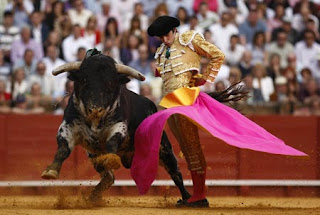
In these here United States it is difficult to find someone who does not have an opinion one way or the other when it comes to bullfighting. It is either a barbaric and cruel relic of a less civilized time or it is a beautiful art-form and sport that represents a distinct and significant culture. I’ll be more than happy to admit that I am a bit biased towards the latter though I cannot say this has always been the case. The very first time I went to a bull fight I found myself aghast at the brutal nature of the sport. My American sensibilities wanted to shout that this is animal cruelty and this is barbaric and this is obscene! But I was missing the point. That isn’t what bullfighting is about. There is an anecdote, I don’t know how true it is, where Orson Wells was at a dinner at Hearst’s Castle and described an occasion where he sat at the knee of famous Spanish matador, Manolete, and Hearst remarked,“It is barbaric. Of all of man’s sadisms, nothing is more depraved than his cruelty to animals.” Mr. Wells took umbrage and replied quite sharply, “In Spain, sir, the cruelty would be in denying the beast a fighting end. As in your magnificent zoo, for instance.” Point being that there is always more than one point of view.


Last time I went to a bullfight was back in 2004. I was in Spain, in Pamplona, for the Festival of San Fermin and during each day of the festival there are bullfights in the afternoon. There was one matador in particular who had everyone’s attention. I don’t remember his name or any details about him other than that he was a relative newcomer who was making quite a name for himself. Every evening four bullfighters would find themselves in the arena three or four times, each one vying for the adoration of the audience. Each flourish of the cape and confident stride in to harm’s way was an attempt to command the crowd as well as the beast. This particular young matador was all of 19 years old I believe, and perhaps he had such confidence because he had not been instilled with the fear that some of the more mature fighters might have.


His stylish propinquity to the animal, the bravado and showmanship, his very presence captivated the crowd, half of which was under the shade of the stands, the other baking in the hot July sun doing all they could to quell the heat with bottle after bottle of sangria. This young matador demonstrated his mastery over the animal, looking him dead in the eye every time the beast charged, its calamitous hooves shaking the earth beneath them. After the colored barbs and lances, the taunts and runs back and forth across the arena, the matador presented his sword, his estoca, to the adulation of the attendants all clothed in white and red and wine. You know the old Looney-Tunes episodes where Bugs Bunny is fighting a bull and you see the bull dig it one of its hooves into the dirt before it charges? That really happens! Prior to seeing it in real life I thought it was just a comedic exaggeration. But finally it comes to one last charge. I don’t even know how one practices for this- standing your ground in front of a charging, angry, 1600 pound beast with nothing left to lose. A flourish of the cape and the bull builds up speed, charging and thundering through the screams of the crowd, the glare of the matador, and weight of certain death. Stepping to the side, missing the bull’s horns by just inches, and with just a fraction of a turn his blade is gone, disappeared into the hulking neck of the beast. The bull, not knowing he is already dead, spins around and begins his charge again and with that the banderilleros and other toreros rush in to, shaking their capes to distract the animal and keep him from goring the bullfighter but he calmly waves them away. Coming to the austere realization of what has befallen him the bull slows down as he comes upon the matador. Their eyes meet and the bullfighter rests his palm on the beast’s forehead as it falls into sleep one final time.


This kid, whatever his name was, gave an equally impressive performance every time he had the floor. Rapturous applause engulfed the ring at his every appearance. He made the cover of the local newspaper and was shown on the evening telecast. It was pretty amazing and to me he seemed like the very incarnation of Pedro Romero from The Sun Also Rises.


So there is the anecdotal part. Now for some history and technical stuff that might be of interest: Bullfighting is found in many Spanish speaking countries like Spain, Mexico, Columbia, Venezuela, Peru, and Ecuador. It’s most direct early ancestor probably dates to the various games held in coliseums of ancient Rome. People vs people, people vs animals, animals vs animals… it all happened throughout the Roman Empire. Prior to that, pretty much ever since there was man and ever since there have been animals one has been killing the other- usually for food, sometimes for sport, and not uncommonly for sacrifice. There are cave paintings dating back to 200 years Before Christ that show a man facing a bull. Of course it was the Spanish who spread the sport to Central and South America and it was not uncommon for these games to take place at important events like weddings and funerals. According to Wikipedia, The modern style of Spanish bullfighting is credited to Juan Belmonte generally considered the greatest matador of all time. Belmonte introduced a daring and revolutionary style, in which he stayed within a few inches of the bull throughout the fight. Although extremely dangerous (Belmonte himself was gored on many occasions), his style is still seen by most matadors as the ideal to be emulated. Today, bullfighting remains similar to the way it was in 1726, when Francisco Romero, from Ronda, Spain, used the estoque, a sword, to kill the bull, and the muleta, a small cape used in the last stage of the fight.

One particular throwback to the gladiatorial days that still exists is that the bull has the chance to win his freedom. Though it is an extremely rare occurrence, if a bull is valiant and impressive enough, the matador will stand and look up at the President’s (or Governor’s) box. If he gets the indication from el Presidente to spare the animal’s life, the animal is taken from the ring and gets to live out the rest of his days in fields of green, put out to stud from time to time.

Of course as time has gone by and we have become more “civilized” the sport has fallen out of favor with a huge segment of the population. It is after all a pretty violent sport that ends with either the death of a gorgeous animal or the goring of a human being. So there are definitely protests and calls to end the practice in Spain. On one hand, up until the actual bull fight, the bull’s life is much less terrible than it would be in a commercial farm. On the other it is still a slow, torturous death with almost chance of freedom or survival. And for those of you who weren’t sure, yes- the bull from the fight is used for food. And yes again, it is delicious.


Whatever your stance, the one thing everyone can agree on is that it is a significant aspect of Latin-based culture, from Spain and France to North and South America. I’ve never had the chance to get to a bullfight in Mexico but it seems like it would be something worth checking out.

Sunday, August 8, 2010

Novelas: TV for Audiences who can be Satisfied

My grandmother would usually pick up my brother and I from school every afternoon. We were kids and in all probability annoying as hell but she pretty much gave us run of the house- baseball in the back yard, board games in the patio, action figures and toy cars… We seldom got in to trouble but when we did she certainly reminded us who was in charge. All afternoon she even gave us control of the TV. But that ended as soon as evening came and it was time for the novelas. My aunt would stop by. Mom would be over to pick us up after a long day of work. But before we left they had a cup of coffee and maybe some pan dulce and stopped to see something that could not be found on American television.

For a nation that is relatively wasteful in so many ways, we are sure to squeeze every last bit of value out of out entertainment. Some stick, like the 20+ James Bond movies out there. Some, like the last couple of seasons of Friends, hang around perhaps a bit longer than their sell-by date. And still others run the gamut until they become a parody of their origin; shows like The Real World and its spin-offs, or The Bachelore(tte). This is not the case with the telenovelas (novelas for short) that one will find on Univision or Telemundo. Though there have been some attempts to adopt the model for American audiences it is extremely difficult for consumers and providers to walk away from a hit show.

Here is how novelas work: by definition they are on a limited run, usually lasting less than a year. That might seem like just any old mini-series you’ve seen anywhere but the content differentiates the genre from that of a typical min-series. Novelas are always convoluted love stories with twists and turns in the plot. Generally you will see a couple kissing in the first few minutes of the program and something will happen to drive them apart. 120 episodes later they will be kissing again in the final scene. So you won’t find epic wars fought as in Battlestar Galactica, nor will you find stories of brotherhood as in Band of Brothers. The content is completely relegated to the soap opera type of plots with steamy love scenes and tales of lust and revenge. Again, unlike a typical soap opera there is a designated end planned from the very beginning. They can be period pieces or take place in a contemporary setting but the one thing you can count on is that it will end. You may fall in love with the characters and demand more but that simply isn’t the way these work.

American studios have tried to emulate the model of the novela on various occasions but the results have been rather disastrous. A small television unit called MyNetworkTV tried to use the format but interest fell off quickly after their first season. That may be because audiences weren’t interested in investing their time in something they knew would be over in a matter of months, or it could be because the shows simply weren’t any good. It takes an act of God and a bolt of lightning for a show to have a successful run even if it has major star power and a great time slot. Anyone remember the Cosby Mysteries? Or that one show Michael Richards had after Seinfeld? Whatever the case, the American attempts could not copy the success of their Latino counterparts.

This isn’t to say that the genre has not had a profound influence on American television. While shows like 90210 and Melrose Place were essentially prime time soap operas with characters whose histories the audience followed no matter how outlandish the plot might be, prior to the early 90s I am hard pressed to think of many shows with a season long story arch. Sitcoms like Three’s Company or Cheers were essentially stand alone half hour shows that could be plugged into the season in any order. Occasionally there were two-parters or very special episodes that would have some lasting effect that might be referred to in a later episode. But there wasn’t really a sense of the show being mapped out for the season with a specific goal that the audience is searching for. Moonlighting had the basic premise of a guy and a girl who should be together but were not… And audiences watched it in hopes that they would finally get together, not because they knew that’s what was supposed to happen at the end of season 2. Fast forward to the early 2000s to the appearance of Heroes, Desperate Housewives and 24. Both of these shows had a very specific story arch that would find a conclusion at the end of the season while setting up events for the season that followed. Audiences were captivated by the notion that their time spent in viewership would be rewarded with a conclusion to the story. Had any of these shows simply ended after their first season they would be regarded as culturally significant events that captivated a nation. Instead they are being milked for all they’re worth and have fallen into mediocrity, a step away from oblivion. Ugly Betty was originally supposed to be ABC’s attempt at an American novela but they decided they would rather ride it out until it eventually got cancelled due to dwindling ratings. Twice.

Like soccer, I’m not entirely sure why novelas won’t catch on in America. I guess it’s the same reason we have a fourth Indiana Jones movie and those last three Star Wars abortions. If we can squeeze a few more bucks out of a character, we probably will line up to see it. By the way, let me know how The Real Housewives of DC turns out.

Wednesday, June 9, 2010

The Crying Woman

As you stroll along the lakeside you listen to the gentle lapping of the water on the shore. The moon glows in a blood-orange hue just above the horizon as dusk falls over you. In the distance fireflies bounce and bob over the tall grasses that peek out along the waterfront. The ground is moist beneath your feet and the soil softens beneath your every step as you walk along, admiring the moon’s reflection over the lake, the chirping of the crickets, and the occasional call of an owl. But then something seems off. You suddenly feel warm over one side of your neck and you look over your shoulder; it’s the unmistakable sensation of the invisible pressure of someone else’s gaze falling upon you. You know you’re being watched. The speed of your steps increases. More than just speeding up, a draft washes over you, blowing against you, trying to push you back but you press on. You’re almost running now and it’s at this point that you realize you only hear the crunch of the grass and soil beneath your feet. No more chirping crickets. No more hooting owls. The water is completely still as you come to a standstill. Where did the fireflies go? All you hear is your own breathing coming in shaking, stammering, gulps. Then you hear something else. It could be your mind playing tricks on you but you hold your breath to make sure. It starts off like a moaning but that’s only because it sounds muffled, off in the distance. You want to run but you don’t know where the sound is coming from and it’s impossible to tell if you’d be running towards it or away from it. The moaning gets louder but it isn’t just moaning. The pain is the same but it is something more. Wailing. Weeping. As though the world around you is crying for something that’s happened. Or. Something that’s about to happen. Something that cannot be stopped or prevented. It’s the crying of a woman who has lost everything. Soon the crying is everywhere- it’s upon you. And it’s the last thing you hear…

La Llorona is a cautionary tale told throughout Latin America. Think of it as the Sleepy Hollow story of the Spanish speaking world.

There are many different versions of the story but the bare bones of it is this: There was a woman who killed her own children to be with the man she desired. She was subsequently spurned by her lover and as a result she killed herself. However, because of her atrocities she is forced to wander (usually near a body of water), weeping for what she had done, weeping for her lost children and looking to replace them. She is looking for her children and will often take children who misbehave or wander off.

Needless to say it has scared the hell out of many, many children.

It is difficult to say exactly where this story originated as there are examples of similar tales all over the world. Among the ancient Greek gods, the big guy, Zeus, had an affair with Lamia. When Hera, Zeus’ wife, learned of the affair she forced him to give up his relationship to Lamia who was then forced to eat her own children. Out of jealousy, Lamia preys on human children and eats any that she catches. The Greeks have some pretty messed up stories. Other variations of La Llorona’s story say that those who hear her weeping are marked for death, not unlike those who hear the wailing of the Gaelic Banshee. Other possible origins of the story point to the Spanish invasion of the Aztec empire. Some say the goddess Cihuacoatl is weeping for the fall of her people. Others point to La Malinche, a native woman who served as an interpreter for Cortes and turned her back on Mexico. Though there is no hard evidence to support it, some say she bore the conquistador a child and was later abandonded.

An interesting website that provides more detailed aspects of the current legend of La Llorona can be found at www.lallorona.com/la_index.html. It tells different stories of La Llorona as a witch, a harlot, a siren, and a virgin. They get a little creepy so don’t read them late at night by yourself.

As for why the story exists, like most stories it is probably a cautionary tale. On one level it is meant to keep children from wandering off. Like the boogey man or Michael Jackson, these characters are meant to frighten children and keep them away from strangers. It is also a warning for young women to either avoid being enticed by the wrong man, or to remember the sacred duties of a mother. Pre-Columbian women had a lot more power and influence than their conquered descendants. The European conquerors did not have the same idea of the sacred feminine that the indigenous peoples of the Americas had and as such did many things to destroy their ideas of the role women should have in society. That’s just the way it went and the story of La Llorona, a woman who is forced to an eternity of misery because of her failure as a wife and mother, may have been a part of that.

Whatever the origin of the story, it is a scary one. It’s certainly enough incentive to keep it in your pants a little while longer. Because if you’re getting down to it and the woman starts weeping… well, I can’t imagine any good will come of that.

Tuesday, May 4, 2010

It Isn't Independence Day?

With Cinco de Mayo fast approaching I am reminded of the many times my grandparents would regale me with stories of how when the holiday would roll around, back in the old country, they would round up the kids, my parents and aunts and uncles and cousins, and head over to El Torito or Chevy’s or TGIFridays to drink margaritas and take shots of Cuervo Gold, or maybe head over to Chili’s to celebrate around an order of skillet queso. Yes, these are the time honored traditions used to celebrate Mexican independence day.

OK, here’s the thing about that: May 5th is not Mexican Independence Day. Beyond that, I’ve already been over what a cheap and disgusting swill that is the product of Jose Cuervo. Those chain “neighborhood grills” and cantinas… their celebrations for “Drinko de Mayo” are somewhat less than authentic. And lastly, Cinco de Mayo is not really a widely celebrated holiday in Mexico and here’s why-

Imagine you are in Canada in the winter, say mid-January, and while strolling through the exciting and inviting streets of Toronto you notice lots of red white and blue adorning the windows and doors of many of the shops and restaurants with exciting fliers promoting festivities on January 26th with promises of Jack Daniels and apple pie and cheeseburgers, you’d probably want to know what it was all about so you ask one of the natives. Eh, he’d reply, what’s all this shite aboot, you say? Why it’s the 26th of January, of course! Isn’t that American Independence Day, eh? What a hoser- you don’t even know your own holidays! January 26th, for all of you non-history majors, is the end of the Battle of New Orleans which was the last major battle in the War of 1812. It’s significant because it was an American victory in a war where the British pretty much bitch slapped us, and also because the battle took place after the war was over (no email in those days). But despite the significance of that particular battle, not really significant in the long run to American history. There was no territory that was won or lost. There were no advantages or advancements made. It really has no real bearing on modern America whatsoever except that it ushered in an era of national pride for several years until the eruption of the civil war. Cinco de Mayo is sort of the same thing.

Mexico’s Independence Day is September 16th. It’s a national holiday and celebrated nationwide. Cinco de Mayo is celebrated somewhat in the state of Puebla because it commemorates the Battle of Puebla in 1862 where the Mexican Army, which was more like a militia made of farmers and laborers, held off the invading French Army. The Mexicans were greatly outnumbered by a better equipped opponent who had not been defeated in 50 years. Since then, no country in the Americas has been invaded by a country from another continent.

Despite the great victory on this day there are a few reasons why the holiday is virtually ignored south of the border. First, is defeating the French really that big of an accomplishment? Not so much. But beyond that, the Battle of Puebla merely delayed the inevitable. Soon after that battle the French sacked Mexico City. Within a year the French occupied Mexico and installed their own guy, Maximilian I, as Emperor of Mexico. And the reason the Mexicans were at war with the French in the first place is not exactly the most honorable reason to go to war: the Mexicans stopped paying money they owed to France. Mexico owed money to several countries and stopped paying all of them because there simply wasn’t any to pay. France originally attacked to force payment of the debt but decided to take over instead- think of the current state of the auto industry, banks, and health care system. So, no, it was not a battle with great and long lasting results for the Mexican people. Eventually France was pressured by the United States to get off our continent and by 1867 they made their way out. Maximilian was deposed and executed as well. Moral of the story: be careful when you borrow money; don’t be French.

So clearly there is plenty of reason as to why this is not a point of pride in Mexico outside of Puebla. But why the prevalent celebration in America? That answer isn’t so clear. Some say Americans have been commemorating the date since 1863, just one year after the battle, to acknowledge the Mexican resistance against France. Beyond that it seems to have become one of those days that, while seemingly arbitrary in America, is used as an excuse to celebrate one particular culture and a reason to drink very very much. Like St. Patrick’s Day, Chinese New Year, or Oktoberfest, on Cinco de Mayo everyone can be a little bit Mexican (except in Arizona where the new Juan Crow law states you had better have your papers on you if you intend to go around supposing to be Mexican).

EricV123 is not a big believer in partying on May 5th because it doesn’t really mean that much to me. Again, were any of you out celebrating on January 26th? But if you must exude your mexicanity I do have a couple of recommendations. If you are in Los Angeles head on over to Olvera Street, the oldest street in California, for some genuine Mexican-American culture and some of the best taquitos and handmade tortillas ever. In San Francisco go see what the Mission has to offer. If you are in Phoenix, stay inside lest you get rounded up and deported for not having your identification on you. Also, on the west side of LA, head on over to Pink Taco, a Mexican-American themed cantina at the Westfield Shopping center on the border of Century City and Beverly Hills. Tell Amy the bartender that EricV123 sent you. You’ll recognize her by her big… uh… eyes.
Just don't be these guys.

Friday, April 30, 2010

Beware The Red Grasshopper!


If you were born after 1985 and did not have an aunt or grandmother who watched Spanish language television, you probably have no idea who El Chapulin Colorado is. For a more contemporary example in the English speaking, American world he has been caricatured on The Simpson’s by the loveable Bumblebee Man. As for yours truly, I remember spending hours in front of the television, many of them over the years, literally rolling on the floor laughing (this was many years before “rofl” was used as an expression [or the existence of IM or text message for that matter]) at the heroic antics of El Chapulin.


So who is El Chapulin Colorado? His name translated means “The Red (colored) grasshopper”. An interesting side note is that the word for grasshopper in this case, chapulin, as actually exclusive to Mexican use. Its etymology comes from an Aztec or Nahuatl word according to the infallible resource, Wikipedia. The Spain-Spanish word for grasshopper is saltamontes. But El Chapulin is more than just his name- he’s a superhero. Sort of. He is recognized by his red and yellow costume (no cape), marvelous antennae, and his heroic chest adorned by a yellow heart bearing the letters “CH”, but believe you me, he is much better than sugar. He also wields a hammer, not unlike the Mighty Thor, called his chipote chillon (squeaky mallet). No matter where his adventures took him he was instantly recognized. Seriously. It could be the past or the present. It could be London or China. It could be the planet Venus. He could be fighting martians… They all know and respect El Chapulin. His powers seem to include, but are not limited to: flight, teleportation, and his vinyl antennae would blink whenever trouble was near- a grasshopper sense, if you will.


Despite all of his noble attributes, most of his success in battling evil doers came by chance, mistake, or simple coincidence. Think Real American Hero, but more brilliant. He even had his own introduction and set of catchphrases to assist in his heroic witty banter. He was introduced, Más ágil que una tortuga, más fuerte que un ratón, más noble que una lechuga, su escudo es un corazón... ¡Es el Chapulín Colorado!
(More agile than a turtle, stronger than a mouse, nobler than lettuce, his shield is a heart... It's the Red Grasshopper!)

Some of his choice lines include:
• "¡Síganme los buenos!" ("Good guys, follow my lead!") — as he would sometimes later on walk into a wall or fell from where he was standing. It would occasionally prompt the villains to say later on "¡Síganme los malos!" ("Bad guys, follow my lead!")
• "Lo sospeché desde un principio" ("I suspected it all along") — which he would say after someone pointed out something obvious that he had missed
• "Lo hice intencionalmente, para..." ("I did it intentionally, to...")- to justify a dumb action, for example: "I did it intentionally to calculate the resistance of the wall", after walking straight into it.
• "Todos mis movimientos están fríamente calculados" ("All my movements are coldly calculated") – his explanation for falling on his face, breaking something valuable, etc. May be spoken stand-alone, but always follows the previous quote.
• "Se aprovechan de mi nobleza" ("They take advantage of my nobility") — which he would usually say after an insult, like "We should've called Superman or Batman...", or when he is forced to do something against his will)
• "Yo opino..." ("In my opinion...") — a phrase always left unfinished because someone always interrupts him. Sometimes with "¡No opines, Chapulín!" ("Don't give your opinion, Grasshopper!"), but mostly with others insisting on their point, not letting him bring it up again.
• Also, in trying to provide advice, he would take two traditional two-part Spanish sayings and mix them up, always beginning with "Como dice el viejo y conocido refrán..." ("As the old and well-known saying goes..."). For example, "Cría cuervos y te sacarán los ojos" ("Raise crows and they'll pluck your eyes out"; i.e., what goes around comes around) and "Crea fama y échate a dormir" ("Make a name for yourself and then go to sleep"; i.e., once you have made a reputation for yourself, things will take care of themselves) become "Cría cuervos y echate a dormir... No, no, no... Crea buena fama y te sacaran los ojos... No... (in this part, he begins to mix both wrongly said quotes creating an elongated phrase confusing both himself and his listeners) "Bueno, la idea es esa." ("Raise ravens and then go to sleep... No, no, no... Make a good name for yourself and they'll peck out your eyes... No... (in this part, he begins to mix both wrongly said quotes creating an elongated phrase confusing both himself and his listeners) Well, that's the idea.")
• "Que no cunda el pánico" ("Nobody panic") would become "Que no panda el cúnico" ("Pabody nonic").


His show originally started running in 1970 in Mexico. It was aired for many years to follow in countries all over the world. It was actually a pioneer in using Chroma-Key (blue screen) visual effects that might look cheesy now but at the time were about as cutting edge as it got. After the initial run of half-hour shows, El Chapulin eventually found his way into doing miniature adventures and skits on the show, El Chavo del Ocho, which is a whole other animal.
I encourage you to learn more about Mexico’s greatest superhero at http://www.chespirito.org/.
Here's a classic clip concerning the mystery of the missing eggs. Trust me... this was groundbreaking stuff.

Tuesday, March 9, 2010

El Cholo

If you’ve lived in, visited, or even just driven through East LA, you’ve probably seen a cholo. Cholo culture has many aspects and variations on the style. Sometimes a cholo will have a shaved head. Or he might have a long black mane pulled back in a tight ponytail. A mustache is not uncommon. Various tattoos may adorn the cholo’s body, usually in tribute to Nuestra Senora, the Raiders, his own last name, or a picture of his heina. Baggy clothes are also the norm but the style of loose fitting clothing is quite different from the urban hip-hop scene. When a vato wants to look good, he doesn’t look for baggier clothing and shiny, plastic bling. No, the vato is more likely to use some extra Tres Flores in his hair, make sure his mustache is trimmed, and while the clothes may still be oversized, he’ll want to look sharp which means pressed trousers, clean shoes, a starched shirt with suspenders, and a small gold chain that is visible when the vato leans back and looks out at the world before him. Casual wear consists of khaki chinos or very long shorts, Dickies that reach to or below the mid-calf, a white t-shirt or tank top, and on top of that maybe a long sleeve shirt that is only buttoned at the top. You can find him in a low-rider Chevy or Cadillac, on a low-rider bicycle, or kicking rocks. A bandana over the forehead, low to the eyes is typical as well, as is a hairnet, but of course not both at the same time. Plaid flannel jackets come out when the weather gets cold. Oh yeah, and knee-high white tube socks. Can’t forget the socks.

Cholo style is heavily associated with gang culture and this association is not unfounded. I’ve got a few primos who got into their fair share of trouble coming up in East LA. Luckily my parents had the drive and ability to see to it that their progeny did not grow up calling one another “ese”. Despite the bad seeds who might ruin a party, these are the guys with tear-drop tattoos and a big black 13 on their chest, there is some overlap with legitimate styles and cultures like the low-rider scene, various styles of art including graffiti art like Chaka and the tattoo art of the Mister Cartoon. A great example of how these characteristics merge with various aspects of black culture and Caucasian “style” would be to take a look at the Long Beach Dub scene that was enormously popular in the west coast during the late 1990s. But for a good, hard look at how the Mexican street gang culture has pervaded a segment of society, watch the 1993 film Blood In, Blood Out (Bound By Honor) or American Me from 1992.

The etymology of the term “cholo” is somewhat ambiguous and the way I am defining it is exclusive to the southwest, Southern California in particular. Anywhere else the term is used it is generally meant to refer to indigenous peoples, those of mixed race, and in its first written usage going back to the early 1600s was synonymous with “mulatto”. During the ethnic power movements of the 1960s the term was used as a point of pride but in general the title has negative connotations. Prior to that, the cholo scene seems to have evolved out of the pachuco fashion from the 1940s. I’ll spend some time on the Zoot Suit in the future, but this appears to be the starting point for what would become cholos. This is why the fancier cholos will wear the creased pants and may go for the fedora over the bandana from time to time.

Cholos like to drink and smoke (it’s not all Cheech and Chong but that is the ideal). If they are in a gang or rely on the streets to survive then it isn’t likely that they have finished high school- these are of course generalizations and not hard and fast rules. As such they will have their own localized method of speech, a spanglish all its own. This isn’t the typical spanglish where one might say carro instead of coche, or always answer with “que” when “mande usted” would be more appropriate. No, this is more like saying “watcha,” or “trucha”. They’ve also got a penchant for mariachi music though everyone has always got their own taste, from hip-hop to reggae and rock. And of course, there are the women, the cholas.

Oh, the cholas. A cholo likes a girl whose hair looks wet but when you touch it, it’s crunchy. Dark lipstick, eyebrows that were drawn in with pencil (or a Sharpie marker), and clothing not terribly dissimilar to their male counterparts; these styles have actually found their way into the mainstream as they have at times been picked up by pop stars like Gwen Stefani, Fergie, and Kat Von D. Typically the cholas are girlfriends or sisters of cholos but they have been known to be some pretty rough and tumble chicas in their own right.

So what do you do if you run on to a cholo or group of cholos? For the most part, just like anyone else you pass by on the street if you ignore them they will ignore you. But if by chance they want to engage in scintillating conversation they are likely to ask you where you are from. They are not planning a trip soon, nor are they eager to exchange pleasantries about the subtle differences from one sociological sample to the next. If a cholo asks you where you’re from your reply should always be “Nowhere. I’m from nowhere”. Just wanted to give you a heads up on that one. In the event you believe you will be deep in cholo territory for any extended period of time you may want to have some Raiders gear on or near you at all times so that a) they may take you for one of them, or b) you can give it as a peace offering or use it to distract them while you pull the knife out of your leg.

Also, don’t let their love of all things Raiders fool you into thinking you can have a chat with them about the NFL. You must never talk to them about football in any greater depth than by simply saying you love the Raiders. This is for two reasons: the Raiders suck and haven’t had a winning season in nearly a decade, and despite their professed adoration for them, cholos don’t know shit about the Raiders other than the colors and the logos.

Also, do not confuse the cholos I've described here with the Los Angeles and La Habra restuarant, El Cholo, which serves a delightful deep fried ice-cream.

Tuesday, February 23, 2010

Do They Celebrate That Over There Too?

Throughout my life I have often been unable to answer the question, “Do they celebrate that in Mexico”? With so many holidays throughout the year I’ve had that very same quandary myself. Of course certain American National holidays like 4th of July and Presidents Day are exclusive to these here United States while Mexico celebrates the anniversary of their own independence and has their own set of national holidays. Others that are founded in the Christian tradition are also pretty obvious as those who colonized the Americas from one end to the other were all Christian. Of course, as demonstrated with Christmas, the extent to which these events are celebrated may vary. There are some holidays that one might think are great big festivals in Mexico (like Cinco de Mayo), but they are not. And then there are those that fall in to a gray area. Canada celebrates Boxing Day but we don’t. We celebrate Labor Day and Valentine’s Day, one a secular holiday and the other a semi-Christian holiday, but what about other places?

The simple and boring thing to do would be to make a list of all the holidays that are celebrated both here and south of the border but no one wants that. Instead how about we just look at a couple of the ones that come to me off the top of my head?

Valentine’s Day happens to be one of those special occasions that comes into question and, as a matter of fact, it is celebrated in Mexico though the emphasis is a little different. Dia del Amor y la Amistad has it right there in the name: Day of Love and Friendship. While there is the romantic aspect of the holiday, where couples make the extra effort to be that much more amorous with one another, the day is also a celebration of platonic relationships where friends may simply do a few extra nice things for each other.

Mexico has a version of Labor Day recognized on the first of May. They also celebrate Columbus Day on October 12th. Is Flag Day a real holiday? I don’t have an answer for you guys on that one but it is on the calendar both here and in the United Mexican States. Because America has exerted such cultural influence worldwide many of our celebrations have been adopted or emulated across the globe. Unfortunately it doesn’t go the other way quite so much and that’s a shame because I think we’re missing out on so many potential days off. Mexico has so many more days dedicated to saints than we do; we really only get Saints Valentine and Patrick while they get Antonio de Abad (where you can bring in your animals to the church to be blessed- how has this not caught on in San Francisco or the Upper East side?), Saints Joseph, John the Baptist, and of course All Saints Day.

One on which I get questions every year is Cinco de Mayo. The assumption is that this is a huge, nation-wide celebration that unites all of Mexico. This is not really the case. When this day approaches I will tell you why this is the case and explain why Americans partying on Cinco de Mayo is sort of like if Canadians suddenly started drinking every January 8th to commemorate the Battle of New Orleans at the end of the War of 1812. Until then, just sit tight in knowing that it is not Mexican Independence Day (September 16th).

In the mean time, I encourage you all so find any justifiable occasion to raise a glass and say "Salud!"

Monday, February 8, 2010

Futbol (Not Football)

In nearly every country in the world the most popular sport with the greatest and most popular star athletes is soccer. Every country, that is, except for these here United States. For whatever reason it has never taken on the same fervor here that is so prevalent across the globe. I don’t know what the exact reason is for this. I was never that in to soccer coming up because no one was really all that in to soccer. Sure I played on teams as a child but professional soccer matches were not televised nor did they get any mention during the sports segment of the news. Time I’ve spent abroad has at times coincided with some pretty big tournaments like the World Cup and the Euro Cup and sitting in the pubs and cafes watching these games was as exciting and enthralling as any Super Bowl or Championship series I’ve seen here in America. It is certainly a hell of a lot more engaging than watching baseball or golf on TV. For the life of me I do not understand why soccer has failed to take hold in America but I have a few theories. It could be that because soccer matches only have one break with no “time-outs” it does present a challenge for selling advertising spots. Halftime is the only opportunity to run commercials and although this is a much more cynical explanation it is a possibility. Another reason might simply be the American mode of thinking. In country founded by people looking to separate from European models and built by those looking for the next big thing, the newest frontier, the greatest opportunity matched only by the risk… Well, I guess what I’m getting at is that American audiences are rarely satisfied with a tie score and have little patience for low scoring games. At least hockey games come with fights.

You say football anywhere besides here and people think soccer. I’m not even sure how we got the name soccer though I understand the word originated in England to distinguish the sport from American football which was gaining popularity here. Even in Mexico where it might make more sense to call it pelota de pye, they call it futbol.

The game we know as soccer does come from Europe though there have been sports associated with kicking or carrying a ball in the Americas going back to the Aztecs. They did have courts or fields with circular goals at either end but it would be presumptuous to say this game influenced soccer because the sport as we know it is generally thought to have been brought over from Europe. The first recorded organized games with an agreed upon set of rules comes from England. It is widely believed that soccer was brought to Mexico by Cornish miners in the late 19th century. It was not much later that a league came about.

Futbol became a professional sport in 1943 and its most successful team with has been Guadalajara with 11 championship titles. Before that there had been professional teams but the league that is in place now has began in 1943. Internationally Mexico has hosted the World Cup twice but has never won but they do have a very respectable team.

Here in the United States soccer has been around for just as long but did not really start gaining popularity until we hosted the 1994 World Cup. The US soccer team did surprisingly well, advancing to the quarter finals but losing to Germany who would eventually take second place. A couple of years later Major League Soccer got its start and many of the members of the US national team took spots in the ten inaugural teams. The US Women’s soccer team has been a powerhouse in recent years and has garnered much international recognition by winning two Women’s World Cup championships in the past ten years. Popularity of the new league went up and down with the national team’s success (or lack thereof at various times) but overall has gone way up from where it was. In California in particular a couple of recent events have greatly increased the exposure of the sport. There was the addition of the expansion team Chivas USA (the Chivas is a very popular team in Mexico), and the recruitment of international star David Beckham. Some would argue that bringing Beckham on board is sort of like the equivalent of taking Brett Favre over to play in Europe’s NFL- he’s kind of past his prime but still has some skill and definitely will draw a crowd. Even still, despite its recent rise in attendance and viewership, the American soccer program is still in its infancy compared to the rest of the world.

This year’s World Cup is going to be held in South Africa while the usual suspects like Brazil and Portugal are expected to do well there are still high hopes for the teams here in North America. Mexico and America are the second highest ranked teams in their respective groups but neither team is favored to win it all by any means. Still, it should be fun to watch.

On a personal note, every Mexican kid has played soccer growing up. I may have gone to school in Orange County but I knew the basics of soccer far before I understood football or basketball. This could also be due to my near complete lack of physical prowess but to my credit I did score the winning goal of the only game my junior high school team won. It wasn’t the highlight of my entire athletic career but it’s up there.

Wednesday, February 3, 2010

I'm Supposed to Appear Mexican

I’ve been told I don’t look Mexican.

I suppose I don’t carry many of the characteristics that come to mind when one thinks of the physical attributes of our cousins south of the border. Usually when one thinks “Mexican” one thinks of any of the following traits: tan skin, dark eyes and hair, probably on the shorter side, Mexicans are not known for being particularly thin or large when it comes to body types, and I could go on. As for myself, I have the dark eyes and hair but definitely not the tan skin. I’m not tall but not all that short. On the occasion we’d stop by the Calimax in Tijuana I felt like I could be on the Olympic basketball team. When people do take a stab at guess where my forefathers come from I typically get guess from the Mediterranean like Italian or Turkish or Israeli. I’ve gotten many countries from South America, the Caribbean and even the generic “white”.

Perhaps I don’t carry many of the stereotypical traits, I’m no Eric Estrada or Don Francisco, but then neither is Linda Carter (and Wonder Woman just happens to be half Mexican). I’ve touched on the many influences on Mexican people plenty of times before when it comes to food and celebration but not the physical traits of the people. What is a Mexican supposed to look like?

My closest friends, like me, are the children of Mexican immigrants. One of them has skin that, while not as light as mine, is still pretty fair. He’s 6’3”. The other is about my height but has reddish brown hair almost as red as his mother’s who also happens to have green eyes. Anyone remember that show Gilmore Girls? The girl who plays the daughter, Alexis Bledel, is a very fair skinned young woman has very very blue eyes. These are just a few examples of different Mexicans can appear. We could be that blond haired dude with the green eyes. We could be that guy with the dreadlocks who might be black (that’s actually my cousin Eddie). We could be in your kitchen right now!

So where do all these different looks come from? All over! Obviously there were the indigenous people who already lived what we call Mexico and the western United States all the way down through South America. These were different cultures with their own varied physical traits and aspects and are the reason I can barely grow facial hair today. Without getting in a big demographic and anthropological analysis I can say that these indigenous peoples greatly influenced the idea of what a prototypical Mexican is supposed to look like. Since it is Spanish that is mostly spoken in Mexico (each of the specific native groups still thriving in Mexico has their own language) we tend to only think of people from Spain who colonized the land. When they decided to go native, akin to John Rolfe and Pocahontas, we called their progeny “mestizos”. The word is derived from the Latin word for “mixed” but its use was synonymous with calling someone a bastard. The connotation of the word has changed since then and now simply refers to one who is of both European and native ancestry.

Even when we look at the Spanish we can clearly see that they do not look Mexican. For all intents and purposes they are white, Europeans. That just leads to more and more lines of ancestry as Spain was at various times dominated by Jews, Moors, Romans etc… A not uncommon Mexican last name is Delao (or De La O) which comes from the Irish who came to Mexico. There were Germans, Portuguese, and even Chinese who travelled south from San Francisco once the railroads were built. If America is a melting pot then Mexico is a thick soup. I like to think of it as a nice fondue set filled with nacho cheese.

Anyway, Mexicans clearly come in all shapes and sizes, shades and colors. We’re not just tan and exotic looking like Selma Hayek, we’re also svelte and fair like Alexis Bledel. But we can also be exactly what you think. Like Paul Rodriguez.

Sunday, November 29, 2009

Mexican Cuisine

Describing Mexican cuisine, like describing the cuisine of any country, is no simple task. The varied geography and influences from all over the world have influenced the flavors of Mexican food giving it a panoply of dishes to suit even the most discriminating of tastes. There are a few staples that everyone associates with Mexican food and these are things like beans, rice, corn, and tortillas. Mexican dishes without tortillas is like Japanese food without rice- it’s going to be there no matter what. You may not automatically think “corn” when it comes to Mexican food, but those sneaky Mexicans, they slip it in there without you even noticing. Corn is there in the tortillas, in the masa (the dough) used to make tamales and gorditas, and plenty of other places you might not think to look. It may be inside of you right now! And of course, Mexican food does not have a reputation for being bland which is why various chili peppers, herbs, and spices play a major role on the preparation.

When the Spanish arrived they found that the Aztecs were eating foods made from corn and often complimented with chilies and herbs and eaten along with beans and tomatoes or nopales which are a prickly pear- a type of cactus looking plant. Though it may not have had a Pace Picante label on it, the Aztecs also had salsa by this time. Other foods they ate, foods which are still associated with exotic or tropical climates even though they are widely available around the world, include chocolate and vanilla, avocado, guava, papaya, squash, sweet potato, tomatillos, and some other not so exotic foods like turkey and, having large coastal regions, fish and other seafood. The invading Spanish introduced a variety of animals like cattle, sheep, chicken, goats and pigs. They also brought rice, barley, olive oil, almonds, wine, parsley and spices that were not native to the land. Call it bioterrorism if you like, but I think it makes for some tasty eating. The conquistadors brought Spanish cuisine with them and perhaps it added a new layer of skill to the preparation and perception of Pre-Columbian food, but I really believe the Spanish got the better end of the deal. For those of you who have not been to Spain, I can tell you that it certainly lacks the flavor and creativity of Mexican food.

As stated above, Mexico has a very diverse geography and as such the six regions of Mexico vary greatly in what you can expect from their food. Of course either coast is going to have plenty of seafood. I personally associate the northwest coast with lobster because my family has been visiting Puerto Nuevo in Rosarito since well before I was born. Visiting Cancun I remember seeing plenty of shrimp on the menu.


My father, being from Sonora in the north, remembers having flour tortillas at the table while my mother, hailing from an area closer to Mexico City, rarely had flour tortillas and saw them as a treat and a break from the usual corn tortillas. Regions in the north are going to have dishes with more meat in them as these areas produce a great deal of beef, ostrich, and goat. As you head further south you may find more sauces and sweeter mole on your chicken. Mole is a sauce that is not terribly unlike a savory chocolate sauce; so if you like chicken and you like chocolate then you are in luck. As you head south the cuisine might be more sweet than spicy as they can take advantage of the widely grown produce. Head to Jalisco, the mountainous region in the west, and get ready to have amazing birria, a dish of goat in a spicy, tomato-based sauce. The southeast will get you more chicken dishes that are a bit spicier and that is due to the Caribbean influence. Dish of spicy chicken and rice with perhaps a touch of cocoanut from this area would not be unlike a dish you could find in Haiti. In the Yucatan they have been bee-keeping for thousands of years and so honey makes its way into the food. Find your way into some of the pueblos or villages and that’s where you find cuisine that truly has its roots in the idea of making do with what you’ve got. This is where you can get some of the flavors that you are not going to find at El Torrito like rattlesnake, spider monkey, iguana, grasshoppers and other insects. I haven’t had anything that exotic but I’m rarely disappointed with the taste of any animals I’ve eaten. I’ve got two personal philosophies when it comes to food: 1) If God didn’t want us to eat animals He wouldn’t have made them all out of meat. And 2) If it walks on God’s green earth then I’ll probably eat it someday.

Lastly we get to Central Mexico. This region’s cuisine is heavily influenced by all of Mexico and that makes sense as it has been the cultural and political center of Central America for millennia. They get a little bit of everything but they also have a few dishes that are credited to the region like carnitas, pozole, and menudo( the food, not the boy band), which any Mexican will tell you is THE cure for a hangover.

It’s important to recognize how many different influences have come into Mexican cooking. Aside from the Spanish, other would-be conquerors and immigrants include the French, Irish, Germans, and Portuguese. Each of those nations was once in whole or in part dominated by the Romans who trace their roots to the Macedons or were conquered by the Moors… It’s all in there. We wouldn’t have chorizo without sausage and it didn’t look like the Aztecs were making sausages before the Europeans made their way over. Likewise it’s great to see how much influence Mexican cuisine has exerted across the globe. Ever had salmon with a mango salsa? Or a steak with chipotle? Hell, ever had chocolate anything?

You’ll notice I did not say anything about burritos, or nachos. The reason for this is because that’s not exactly Mexican food. I’ll get to the difference between Mexican food and Tex-Mex soon enough but you should be able to make the distinction between the two by the time I’m done with you. In the mean time, go out and find yourself some real Mexican food if you can. Don’t be afraid of the spicy! Salsa should not taste like ketchup with onions in it, it should give your tongue a tingle. Also, someone please correct me if I’m wrong but I never hear of Mexicans who get heartburn yet I hear of people getting heartburn whenever they eat something spicy. This requires more research.

Wednesday, November 18, 2009

Mexican Food in America

It used to be very rare that I would get a craving for Mexican food. Nights out at the bars and clubs, when others wanted to hit up King Taco (On Cypress in East LA- or the one in Pasadena), I was more partial to grabbing a burger or one of those hot dogs wrapped in bacon from the street vendor at the corner. When meeting with a group of friends and trying to decide what to do for dinner I rarely supported the option of going out for Mexican. That’s not to say I didn’t like Mexican food; I frequently got a delicious burrito from Boca Del Rio or tacos from Mexico Taco in La Habra. The whole family would get together for certain birthdays or holidays at the El Cholo or El Torrito Grill. I was never disappointed. Enchiladas, tamales at Christmas, carne asada… it’s all good. I think the reason I never wanted to go out of my way to get is because it was always around growing up.

My dad used to make bean burritos for me to take to lunch when I was a kid. (Just a little side note- I know that burritos aren’t exactly Mexican food but more like tex-mex, but that’s a topic for another post). Staying with grandma in the evenings she was always making chile rellenos or albondigas or chilaquiles (which remarkably has no chile) or something to that effect. So it was all readily available and, if not that, there were plenty of wonderful Mexican restaurants all over the place.

Then I left Los Angeles.

San Francisco, for all its wonderful cuisine and gastronomic tantalization really has second rate Mexican food. You can find some a palatable burrito here and there but they truly are few and far between. This was confusing to me as San Francisco has the Mission District which is a hub of Latin-Americans. In my naiveté I presumed that would mean there are lots of Mexicans. There are many but what I came to find out is that there is an even greater concentration of peoples from El Salvador. This really puts a damper on the Mexican food for me because it never tastes quite right. Don’t get me wrong, if you want a good pupusa this is the place to go but as for their Mexican food… Well, it’s like kissing your stepsister. It’s better than nothing but it certainly is not ideal.

Then I left San Francisco.

New York also has a wealth of restaurants of every possible cuisine from Ethiopian to Thai to Scottish to Argentine… unfortunately their Mexican food is absolutely bland and tired. Every place I’ve gone has been a disappointment. I’ve only been here a year and tried just a handful of places but each one has given me less of a reason to try another. There is supposed to be a wonderful street vendor in SoHo called Calexico but I’ve yet to get to it. I’ve been told that there are a couple of great places out in the Bronx or in Brooklyn but that’s a trek and I don’t see myself heading out that way for what may just amount to be a Taco Bell is disguise. When it comes to my food, absence does make the heart grow fonder. Now, every time I get back to LA I hit up my favorite Mexican food places. If I’m headed through downtown I may even make a stop at Olvera Street to the place at the end where you can still find the ladies making the tortillas by hand. Standing in line as a child, my brother and I would always head up the steps that looked over the kitchen where we could peer over and watch their hands clap-clap-clap as they formed the tortillas.

My experience with Mexican food in America is limited to California and New York. I’ve been through Arizona and New Mexico (that’s right, there’s a New Mexico!) but I don’t remember my reaction to their Mexican food well enough to comment on it. I’m sure it’s great though. It seems to me the closer you get to the border the more likely you are to find something delicioso y sabroso. Next week I’ll get into some specifics about how crazy Mexican food can get, like eating tongue and brains, roasting up a goat head or the process of making carnitas from scratch. Good times.

Wednesday, November 11, 2009

Why so many Kids?


It’s a stereotype that is not entirely inaccurate, that of a dozen kids piling into the car of a Mexican family. I myself only have one sibling and by Mexican standard that makes for a very small family. My parents also came from relatively small families- my mother as one of four children and my father the same. I do have a couple of aunts and uncles who have had five children and that seems to be a little more like it. But the ones who take the tamale have got to be my buddy David’s parents. His mother and father are one of seven and one of twelve respectively. I’ve got a total of over twenty cousins (just counting the first cousins) and on Christmas it does make for a full house. It was always a sad event find yourself at the back of the piñata line at birthday party because there was absolutely no hope of taking a whack at that thing. But I’ve been to David’s house on Christmas Eve and there are so many Mexicans there you would think they were giving away _______ (insert your own joke here- I suggest the following: Budweiser, Green Cards, jobs in front of the Home Depot, tacos… the possibilities are endless!).

It does beg the question: what’s up with Mexicans having so many kids?

This query does not have one simple answer but I have my theories. First, there’s the reason that all agriculture based economies had so many kids. Just like America prior to WW2, families on the farm needed the farm hands. Same goes for Mexican farms. But that isn’t the only answer. The second reason off the top of my head is Catholicism. There are some strict interpretations of the Bible that some argue prohibit any and all forms of birth control. The old catholic guilt will tell you that the only purpose for sex is to procreate. In fact the only reason a man’s seed should ever leave his body is for this reason otherwise he is guilty of onanism (which is just a fancy dirty word named after Onan, a guy from the Bible). Third, it’s just one of the dominant cultural values. Mexican families place great value on the family and on taking care of one another in a way that is very different from American values. It isn’t as common or acceptable for a child to go away to college far away and never return. Nor is it considered acceptable to place the old and infirmed in an old-folks home. The elders are to stay with the family and that’s that. This sense of family togetherness is related to the desire to have a large family.

I don’t really think there is much else to it than that: the farm, the no-birth-control-of-any-kind, and the family togetherness. To those of you who are waiting to start a family I would suggest this: don’t even look at a Mexican woman the wrong way (especially if she still has her catholic school uniform) because you could end up a daddy before you know it.

Monday, October 19, 2009

Dia de los Muertos


Halloween is soon approaching and various costume shops have popped up all around town. Grocery stores and places like Target are stocked up on gigantic bags of “fun-size” candy and everyone is getting ready to trick-or-treat. Plenty of people engage in Halloween traditions like carving up a jack o’ lantern, playing practical jokes to frighten one another, and going to haunted houses. Those of you who paid attention in history class you’ll remember that Halloween is the word we have for the phrase “All Hallows Eve,” also known as the day before All Saints Day which falls on November first. All Saints Day is a catholic holiday and is followed by All Souls Day. This one-two punch of holiness is collectively known as The Day of the Dead or Dia de los Muertos.

Those of you who really paid attention in history class will know that most of our Christian holidays are placed around ancient pagan celebrations. This doesn’t mean Christian holidays are without significance but rather that their calendar dates were selected out of pragmatism rather than marking the yearly anniversary of an historic event. For instance, say you’re from Spain and trying to convert a bunch of Aztecs to Christianity. Rather than telling an entire nation that their belief system is ridiculous you say, “Hey, instead of sacrificing virgins to the volcano on this day we paint eggs and pretend a giant, mutant rabbit hides them for children to find. Doesn’t that sound much better?” At first people are hesitant to follow along but when they notice that all the hot, young virgins are into it then the guys tend to follow along. My conservative, Christian, jr. high school did something similar. On Halloween they would hold a “Harvest Festival.” It was not a Halloween celebration per se but everyone wore costumes and played games and avoided witches and ghouls and smashing pumpkins and sacrificing virgins.

Like so many other things Mexican, Dia de los Muertos has its roots with the Aztec civilization. The observance goes back to a festival dedicated to the goddess Mictecacihuatl (great triple-word score for those of you playing scrabble!). She, along with her husband, Mictalntecuhtli, rule over the underworld and she, in particular, watches over the bones of the dead and together they make a lovely couple to have over for coffee and board games. She is the original form of a figure still looked to as Santa Muerte. Other indigenous civilizations such as the Olmec and Mayan and others had similar beliefs and observances but we’ll just lump them all together for now. Also, as I said above, Dia de los Muertos is typically celebrated on November 1st and November 2nd. That is because the first day is dedicated to remembering those who never had a full life, like children, and is thus more specifically referred to as the Day of the Innocents. Deceased adults are revered on the second day which is also called the Day of the Dead.

Despite what you may be thinking, Dia de los Muertos is not simply “Mexican Halloween.” Where Halloween celebrations tend to embrace and/or focus on the more macabre aspects of death with a play on fear and all things ghostly in a haunted house type of flavor, Dia de los Muertos is probably more akin to something like Memorial Day but rather than only remembering soldiers who have given their life it is a time to remember all those who have passed. The decorations associated with Dia de los Muertos do have some semblance to American Halloween decorations- skulls, tombstones, death, and things of that sort, they have a much less sinister connotation. Also, in contrast to Halloween where the point of the costumes is to trick or frighten lost souls back to their rightful place, Dia de los Muertos is a time to welcome visits from spirits of those who have gone on to the next life. During this visit you can ask the departed to relay messages and prayers. It is also customary to visit a grave and decorate it while bringing along some of that person’s favorite things and foods. This can also be done in the home. It is not uncommon to find a small altar with a picture of the deceased along with a cross and a picture or statue of the Virgin Mary. It’s a very interesting mix of how a pagan religious observance has melded with Christianity.


Another really cool looking aspect of Dia de los Muertos is the prevalence of skulls and skeletons. These are made in to costumes and decorations of all kinds. More importantly they are made in to candies and cakes. Take a walk along Olvera Street in Los Angeles, or though the Mission district of San Francisco and you will see people in costumes that resemble Jack Skelington from Disney’s “The Nightmare Before Christmas” except that he seems to be wearing some sort of mariachi suit. Then, of course, you’ll have to get a sugar skull and maybe a tamale. There are festivals and parades and all that. What I’ve realized is that recently the practice of kids going trick-or-treating has become popular in Mexico- it’s fascinating how the two cultures are reflecting one another.

There is no one answer to the question as to what Dia de los Muertos is all about. The mishmash of indigenous celebrations combined with a European influence is similar to celebrations found all over the world. I grew up trick-or-treating but I would be the last to turn down a sweet, sugary skull.
-original artwork of a bitchin' Dia de los Muertos themed lucha libre costume provided by nate garcia