Showing posts with label Food. Show all posts

Wednesday, June 8, 2011

The Tortilla

I’ve said it before and I’ll say it again, a flour tortilla with butter is probably the best snack ever. I have held this opinion for as long as I can remember. Sure I’ve had grilled cheese sandwiches and milk and cookies, I’ve indulged in cheese and crackers or apple slices, but for me nothing tops a flour tortilla with butter. It’s simple and delicious and amazing. All it takes is a few moments on the burner until you get just the right amount of crispy, flakey, texture- you can use a microwave in a pinch but it isn’t as good, smear some butter across that round, heavenly circle of flatbread that I can only liken to the manna of the Old Testament, roll it up and be sure to fold up the bottom end so the butter doesn’t drip on to the floor. There it is. A few moments of sublime satisfaction.

Tortillas and Mexican food are inextricable. Like rice with Japanese food, bread with American cuisine, and debt with President Obama, some things are always going to go hand in hand. These delectable disks of delicious dough derived from the kitchens of heaven have a long and stories history which can be found at the Mission Tortilla Factory at Disney’s California Adventure (sponsored by Mission Foods!) but if you haven’t got an extra hundred bucks for Disneyland and you don’t live in California you can get all of this rich and wonderful history for free here at ImSupposedToBeMexican.com because I love you so much. Tell your friends!

Growing up I always had flower tortillas more often than corn tortillas. Corn tortillas were around and they seemed to be preferred by my grandfather. The more durable texture of the corn tortilla seems to be more suitable for scooping up pinto beans and smearing with sour cream or guacamole whereas flour tortillas are better for wrapping up larger quantities of food as in a burrito or enchiladas. Of course these are anything but hard and fast rules. Though I have a penchant for the flour variety I prefer corn tortillas for tacos, the tortilla lightly toasted with a touch of oil or even fried up in to a crispy shell (I do not, however, like those store bought taco shells that seem to be made to arrive at the store already stale). There are other members of the tortilla family which include gorditas, tostadas, and the gordita’s Salvadorian cousin, the pupusa. I mentioned earlier about heating up a tortilla on the range or, if all else fails, in the microwave. But the best way is by using what you will find in most any Mexican household: the comal. The comal is a flat, cast iron piece of cookware sort of like a skillet that is often handed down from generation to generation. It has to be oiled just so, it never leaves it’s spot on the stovetop, and only gets better and cooks more evenly as time goes on. When my parents got the chance to redo their kitchen they specifically sought a stovetop with a fifth burner where the comal would have a permanent home. FYI, though I am a fan of Chipotle and find their chicken burritos as one of the best anglicized examples of how to bring Mexican food to the palates of Des Moines and Wichita, that device they use to heat up their tortillas is sadly inadequate.

So where in when did people’s love affair with the tortilla begin? For the answer to that question we take a look back through the annals of history long before El Pollo Loco was founded in 1975, or even Taco Bell in ’62. No for the whole story we need go back a little further. According to an a passage in Wikipedia which lacks any form of citation the tortilla dates back at least 10,000 years along with a Mayan legend about a peasant making the first tortilla from ground corn for his hungry king. Given their history of farming corn of course it would be the Mayans or the Aztecs who came up with a million different ways to eat corn including using ground corn to make cornmeal and then said cornmeal into cakes and breads which would eventually find their form as a tortilla. This is not far off from the discovery of other tasty treats like popcorn. Anyway, the great and ancient civilizations who pioneered the foundations of our modern systems of mathematics, astronomy, and art, also loved their vittles which is why so many wonderful foods come from the region. Many of these foods were discovered by the conquistador Cortes who brought them back to Spain. These little flatbreads/cakes, called tlaxcalli by the natives, were given the name “tortillas” by the Spanish, their word for “little cakes.” Weird side note: the Spanish have also given the name tortilla to a potato omelet.

With that long and storied history of the corn tortilla I kept searching for some solid data about the origin of the flour tortilla but kept coming up empty handed. While the ancient civilizations of Mexico and Central America were no strangers to wheat flour, corn was the food staple upon which their lives were based. It makes sense now when I find that flour tortillas are more popular in the northern states of Mexico than they are in the southern states. With all of those wheat fields here in the America it’s logical to assume that as the old empires made their way north some suitable substitutions had to be made when it came to dietary preferences. My mother coming from a region just north of central Mexico told me that as a girl corn tortillas were more popular and easy to come by than their flour counterparts. My dad on the other hand, coming from the northern states bordering America, always had flour tortillas around.

As for state of tortillas today, they’re everywhere. In my lifetime alone they’ve gone from being found in the Ethnic Foods aisle to being found in 7-11. They’ve gone mainstream. Head to old town San Diego or Olvera street in Los Angeles and you will still hear the clapping hands of ladies in the kitchen forming round balls of masa into torillas. By the way, if an elderly woman sarcastically asks you if you are making tortillas it’s probably because you are chewing loudly.

So there is your history of the tortilla. Unlike the Disney attraction I can't give you a free tortilla now that we’re through- quick tip, if you’re visiting the theme park on a budget there is no limit to how many times you can go through the little attraction and there usually is no wait time either. Walk through a few times and you’ve got enough tortillas to keep you satisfied and happy for an afternoon!

Some of the other tortilla related foods I mentioned earlier are gorditas, which are smaller, fatter tortillas that can be stuffed or used as a foundation to pile on meat and beans and cheese and stuff. Tostadas are crispy, fried tortillas often used to pile on other food as well. Think of them as tortilla chips that haven’t been cut apart yet. By the way, anyone in my family will tell you my dad invented colored tortilla chips back in the early 80s. True story. But it will have to wait for another time. Until then, my supposed Mexicans, I am heading to my stovetop to make one of the greatest snacks of all time. Adios!

Monday, February 14, 2011

El Matador...


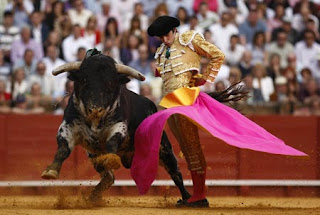
In these here United States it is difficult to find someone who does not have an opinion one way or the other when it comes to bullfighting. It is either a barbaric and cruel relic of a less civilized time or it is a beautiful art-form and sport that represents a distinct and significant culture. I’ll be more than happy to admit that I am a bit biased towards the latter though I cannot say this has always been the case. The very first time I went to a bull fight I found myself aghast at the brutal nature of the sport. My American sensibilities wanted to shout that this is animal cruelty and this is barbaric and this is obscene! But I was missing the point. That isn’t what bullfighting is about. There is an anecdote, I don’t know how true it is, where Orson Wells was at a dinner at Hearst’s Castle and described an occasion where he sat at the knee of famous Spanish matador, Manolete, and Hearst remarked,“It is barbaric. Of all of man’s sadisms, nothing is more depraved than his cruelty to animals.” Mr. Wells took umbrage and replied quite sharply, “In Spain, sir, the cruelty would be in denying the beast a fighting end. As in your magnificent zoo, for instance.” Point being that there is always more than one point of view.


Last time I went to a bullfight was back in 2004. I was in Spain, in Pamplona, for the Festival of San Fermin and during each day of the festival there are bullfights in the afternoon. There was one matador in particular who had everyone’s attention. I don’t remember his name or any details about him other than that he was a relative newcomer who was making quite a name for himself. Every evening four bullfighters would find themselves in the arena three or four times, each one vying for the adoration of the audience. Each flourish of the cape and confident stride in to harm’s way was an attempt to command the crowd as well as the beast. This particular young matador was all of 19 years old I believe, and perhaps he had such confidence because he had not been instilled with the fear that some of the more mature fighters might have.


His stylish propinquity to the animal, the bravado and showmanship, his very presence captivated the crowd, half of which was under the shade of the stands, the other baking in the hot July sun doing all they could to quell the heat with bottle after bottle of sangria. This young matador demonstrated his mastery over the animal, looking him dead in the eye every time the beast charged, its calamitous hooves shaking the earth beneath them. After the colored barbs and lances, the taunts and runs back and forth across the arena, the matador presented his sword, his estoca, to the adulation of the attendants all clothed in white and red and wine. You know the old Looney-Tunes episodes where Bugs Bunny is fighting a bull and you see the bull dig it one of its hooves into the dirt before it charges? That really happens! Prior to seeing it in real life I thought it was just a comedic exaggeration. But finally it comes to one last charge. I don’t even know how one practices for this- standing your ground in front of a charging, angry, 1600 pound beast with nothing left to lose. A flourish of the cape and the bull builds up speed, charging and thundering through the screams of the crowd, the glare of the matador, and weight of certain death. Stepping to the side, missing the bull’s horns by just inches, and with just a fraction of a turn his blade is gone, disappeared into the hulking neck of the beast. The bull, not knowing he is already dead, spins around and begins his charge again and with that the banderilleros and other toreros rush in to, shaking their capes to distract the animal and keep him from goring the bullfighter but he calmly waves them away. Coming to the austere realization of what has befallen him the bull slows down as he comes upon the matador. Their eyes meet and the bullfighter rests his palm on the beast’s forehead as it falls into sleep one final time.


This kid, whatever his name was, gave an equally impressive performance every time he had the floor. Rapturous applause engulfed the ring at his every appearance. He made the cover of the local newspaper and was shown on the evening telecast. It was pretty amazing and to me he seemed like the very incarnation of Pedro Romero from The Sun Also Rises.


So there is the anecdotal part. Now for some history and technical stuff that might be of interest: Bullfighting is found in many Spanish speaking countries like Spain, Mexico, Columbia, Venezuela, Peru, and Ecuador. It’s most direct early ancestor probably dates to the various games held in coliseums of ancient Rome. People vs people, people vs animals, animals vs animals… it all happened throughout the Roman Empire. Prior to that, pretty much ever since there was man and ever since there have been animals one has been killing the other- usually for food, sometimes for sport, and not uncommonly for sacrifice. There are cave paintings dating back to 200 years Before Christ that show a man facing a bull. Of course it was the Spanish who spread the sport to Central and South America and it was not uncommon for these games to take place at important events like weddings and funerals. According to Wikipedia, The modern style of Spanish bullfighting is credited to Juan Belmonte generally considered the greatest matador of all time. Belmonte introduced a daring and revolutionary style, in which he stayed within a few inches of the bull throughout the fight. Although extremely dangerous (Belmonte himself was gored on many occasions), his style is still seen by most matadors as the ideal to be emulated. Today, bullfighting remains similar to the way it was in 1726, when Francisco Romero, from Ronda, Spain, used the estoque, a sword, to kill the bull, and the muleta, a small cape used in the last stage of the fight.

One particular throwback to the gladiatorial days that still exists is that the bull has the chance to win his freedom. Though it is an extremely rare occurrence, if a bull is valiant and impressive enough, the matador will stand and look up at the President’s (or Governor’s) box. If he gets the indication from el Presidente to spare the animal’s life, the animal is taken from the ring and gets to live out the rest of his days in fields of green, put out to stud from time to time.

Of course as time has gone by and we have become more “civilized” the sport has fallen out of favor with a huge segment of the population. It is after all a pretty violent sport that ends with either the death of a gorgeous animal or the goring of a human being. So there are definitely protests and calls to end the practice in Spain. On one hand, up until the actual bull fight, the bull’s life is much less terrible than it would be in a commercial farm. On the other it is still a slow, torturous death with almost chance of freedom or survival. And for those of you who weren’t sure, yes- the bull from the fight is used for food. And yes again, it is delicious.


Whatever your stance, the one thing everyone can agree on is that it is a significant aspect of Latin-based culture, from Spain and France to North and South America. I’ve never had the chance to get to a bullfight in Mexico but it seems like it would be something worth checking out.

Friday, August 6, 2010

King Taco

I don’t have the same tolerance for spicy foods that my father does. When he wants salsa he wants it so hot he is sweating by the time he gets through his meal. And then he wants a little bit more. I don’t like to need a towel to wipe my brow at the end of a meal but I like a little bit of kick and when I ask for something I want it spicy for real, not white-people spicy. Not Cheesecake Factory we-added-some-extra-black-pepper-and-a-touch-of-cayanne-pepper-spicy but something that is going to burn a little bit and will be made worse if you try to wash it away with water. You can get this at King Taco. You can get the spiciness my dad prefers but if you don’t want the burning depth of hell raging in your mouth you can get a decent kick as well. A good salsa makes all the difference in Mexican food. You could have the sweetest corn cakes, the most savory tamales, or the crispiest chips, but if you don’t have a spicy salsa then you are eating at El Torito or, if they’re still around, Alcapulco’s.

King Taco is on my list of musts every time I get back to Los Angeles, which is a few times per year. My family has been a loyal customer since my childhood. After visiting cousins or extended family, friends, after YMCA youth softball games or sometimes after an early Dodger game, stopping by King Taco- the one on Cypress or maybe the one on Third, depending on where we were coming from, was on the itinerary. Over the years as the brand expanded it got easier and easier to find one, much to my delight. Now they even have a spot in Dodger stadium and that pretty much rocks.

King Taco got its start back in 1969. Raul Martinez and his wife, Maria, lit the barbeque at the park (I’m guessing Leg Lake but that information wasn’t available), a bunch of guys playing soccer nearby finished up and passed by to see what smelled so good. They bought a bunch of tacos and BOOM! A legend was created. Five years later Raul and Maria bought an old ice-cream truck and converted it into a taco truck, an innovation that I think we all take for granted these days. Knowing their audience, Raul, Maria, and Raul father, parked the taco truck outside of a bar one night and had about $70 worth of sales. The next night they doubled that. Six months later the first King Taco restaurant with a permanent address opened at 1118 Cypress Ave. in Los Angeles. The rest is history and with just 21 locations from Commerce to Ontario everyone knows if you want a good taco you go to King Taco.

Part of the appeal is the value. Tacos are just a $1.25 and there is quite a variety to choose from. You can go with the simplicity and ease of carne asada, carnitas, or pollo, but for the real Mexicans, the ones who aren’t just supposed to be Mexican but actually know the Mexican National Anthem (I still have to learn that one), they offer lengua, cabeza, buche, and mollejo. I’d love to just tell those of you who don’t speak Spanish exactly what those are but part of the fun is figuring that out if it’s your first visit. I couldn’t in good conscience, ruin for you but I will say it might seem kind of rowdy if you aren’t terribly familiar with Mexican cuisine.

I may be confusing King Taco with Olvera street from my youth but I thought they used to feature Fanta and/or Orange Bang (along with Piña and Lemon Ole!) but they don’t seem to be on the menu anymore. They do, however, still serve aguas frescas which sounds very good during these summer months. Other menu items include tameles, sopes, and chicken but you go for the tacos. Just like even though Lawry’s Prime Rib has lobster, it’s not what you go there for. With King Taco you go for the tacos.

I won’t be making my way to Southern California for at least another couple of months but already my mouth is watering for some of those delicious tacos. So many nights heading back from Hollywood or wherever and taking an exit off the 60 freeway to pull up to the brightly lit sign with shaved heads and Dickies in front of low-riders on one side and LAPD or LA County Sheriffs on the other side. It’s a good mix. Oh, and if you are heading east on the 60, make sure you hit the right exit because if you can see it from the freeway then you’ve gone too far and you’ll have to back track.

Thursday, June 17, 2010

The Mission


Like any well mannered young person moving to a new city to attend college, my priorities in my new home in San Francisco were as such: find a place to live, find a place to get food, and most importantly, find a place for cheap beer. Within the city limits of San Francisco that last requirement is found by so many dedicated students in the Mission District. Nestled pretty close to the center of the city, the Mission sits surrounded by SoMa to the west, Bernal Heights to the south, and the Castro to the east. For such a small city it has always been incredible to me how it can sustain so many distinct neighborhoods with their unique characteristics. Even the most aloof resident of the city (and there are many) can tell what part of the city they are in by the architecture, the shops and restaurants, the bars and attractions, the geography. The Sunset is not Twin Peaks. Pac Heights is not the Presidio. You try to stay away from Hunters Point. And still no one exactly knows where Excelsior is. When it comes to the Mission you will know you’re there by a few distinct traits beyond the cheap beer: due the geography of the city it is probably the warmest and sunniest part of the city; there are two BART (subway) stops; and it is the largest Latino community in the city.

The area has had a Spanish influence since 1776 when Spanish priest Francisco Palou founded the Mission for which the city is named- after St. Francisco de Assisi. Prior to that the area had been inhabited by the Yeluma Indians for over 2000 years but as everyone knows, whenever you mix Europeans and natives… one of them is going to disappear and it will probably the ones who haven’t been making use of gun powder for 1000 years. The Mission that currently stands was built in 1783, probably with forced Indian slave labor. The surrounding area with owned by various Spanish rancheros with names that are still important to the city of San Francisco like Valencia, Bernal, Noe, Guerrero- these are currently names of streets and neighborhoods throughout the city. Eventually the land was ceded in the deal that ended the Mexican-American War. The Gold Rush came and went and along with the rest of the city, the Mission District grew economically by leaps and bounds; it was home to California’s very first professional baseball stadium and had a couple of others over the following century which were home to teams like the San Francisco Seals and the Mission Reds.
Throughout most of the 19th and well into the 20th century, the Mission was mainly a German and Irish community. After the earthquake of 1906 so much of the city’s economic and commercial center in the downtown and financial districts had been destroyed or disrupted that the Mission became the main commercial thoroughfare for a short time. The area saw an influx of Polish immigrants as well but like so many other places, once World War II arrived everything changed.

When so many men left to join the war effort, their families returned to their families or simply moved on. As such this left a void in the housing market and prices and populations dropped. Enter a new group of immigrants, the Mexicans. The Germans, Irish, and Poles had left and the Mexicans seized the opportunity for inexpensive housing. This started happening in the 40s and went well into the 60s and the neighborhood has been a Hispanic community ever since. In the 1980s, civil unrest and instability in the Central America brought many more immigrants to these here United States and many of them reside in the Mission District which is why their Mexican food is substantially subpar when compared to Southern California efforts, but it is probably the best place to get a plate of pupusas.

Over the past decade or so, since it has become the trend for young urban white people to gentrify neighborhoods because it’s “more real” (see Brooklyn; see Oakland; see Echo Park), the Mission has seen a dramatic increase in the white population along with increased housing prices- even Dave Eggers’ charitable foundation, 826 Valencia, is based there. Despite this, the district remains a destination for Hispanic immigrants.

A few things to see and do whilst in the Mission include a visit to actual mission which still stands on Dolores Street, not far from Dolores Park. My favorite rock climbing gym, Mission Cliffs is there. And the Mission is home to many Latino art galleries and cultural centers like Galeria de la Raza, and so many murals all over the neighborhood that were commissioned by the Chicano Art Mural Movement of the 1970s. The Mission has become synonymous with great burritos, too. In fact, there is a restaurant not far from my place in Upper West Side Manhattan that boasts “San Francisco Mission Style Burritos”. Mission and Valencia streets are home to dozens upon dozens of bars, bookstores and restaurants that are host to the annually literary event LitQuake in October. It was home to a punk scene for a while and was even characterized as a Bohemian community akin to Greenwich Village though it’s difficult for any neighborhood close to Haight and Ashbury to co-opt that moniker.

So the Mission isn’t exactly a Mexican neighborhood anymore but it does have strong Mexican ties and a rich heritage. One of the drawbacks to San Francisco’s fantastic BART system is that it ceases to run by 1:00am on the weekends. With the bars going until 2:00am this can cause a crisis of priority. Countless times I’ve found myself enjoying a cold beverage with friends as single tolling of a bell drew near. One more, my friends would say- and I would relent. Then, with just moments to make the last train, I’d run out of Zeitgeist or the Latin-American Club or the Elbo Room, as fast as I could. Half the time I made it, saving myself a $25 cab ride home. The other half of the time my comrades would smile as I walked back into the bar with a bacon wrapped hot dog in my hands as I’d sit down to another beer.

Tuesday, May 18, 2010

Olvera Street


Before the traffic and highways, before the movie studios and fancy shops and restaurants, before anything that would really identify the city as what it is today, Los Angeles was a small village known to its inhabitants as El Pueblo de Nuestra Señora la Reina de los Angeles del Rio de Porciuncula (The Village of Our Lady, Queen of the Angels of the River Porciuncula). It was a tiny settlement of Spanish settlers founded in the area not far from where the 60, 5, 101, and 710 freeways converge. The area remained under Spanish rule until Mexico’s independence (not May 5th) and became part of these United States in 1848. Los Angeles was a sleepy little town with some farm land and cattle ranches, but was not a commercial center. The city lacks a natural port, mineral or fuel reserves, steady rain or irrigation, or anything that makes a major city like New York, San Francisco or Chicago. The city was mostly built on advertising hype and promises of sunshine- for a great look at how Los Angeles was “made” read Carey McWilliams’ Southern California: An Island on the Land. But before the great influx of so many diverse peoples and cultures, before the railroads and the cars brought people from all over, it was a small gathering of adobe buildings, a church, and a red brick plaza. Remnants of this land before America still exist in the heart Downtown Los Angeles at Olvera Street, the oldest street in the city.

As the city grew into the 20th century and the focus was on modernization and growth, Olvera Street, originally known as Wine Street (or Vine Street), fell into disrepair and became, at best, a dirt alley the hidden and neglected in the towering shadows of progress. During this time thousands of people were running towards the American Dream from all over the world and for most Mexicans the destination was Los Angeles.

There would be no Olvera Street today if not for the efforts of Christine Sterling, a wealthy socialite from San Francisco who was residing in the Chavez Ravine area. There were plans for the area to be razed when she took notice of the area in 1926. The place was dark and dirty and home to the element of society that seeks out dark and dirty places. But beneath the dank and din she noticed the Plaza Church that had been built in 1822. She also must have realized that the ancient adobe structure in the center was the home of Francisco Avila, a wealthy ranchero and one-time mayor of Los Angeles. His home was built in 1818 making that particular building the oldest residence within the city limits. Miss Sterling recognized what the street would have been in its heyday realized what a shame it would be to have the oldest and possibly most culturally significant part of the city torn down. Having the money and connections to get real results one can say that she single handedly saved Olvera Street from Los Angeles. She got word to Harry Chandler, who ran the LA Times, got up in front of the City Council, and even managed to get prison inmates to assist with the project. Sterling envisioned a thriving marketplace that would be a romantic cultural center for Mexican and Los Angeleno history. And she was right.

In the end the entire marketplace was rebuilt into a thriving Mexican American marketplace. She even lived in the Francisco Avila Adobe house up until her death in 1963. Today it is designated as a Historic Landmark. Some of my fondest childhood memories come from when my parents would take my brother and I along to a particular restaurant called La Luz del Dia where we would climb the staircase along side the kitchen where we would peer over the railing to watch the women clap balls of masa between their palms to make the delicious tortillas that accompany every dish. Olvera Street has some of the best taquitos, champurrado, tamales, menudo… you name it, you’ll find it- and it will be pretty tasty. There are shops of all kinds from candles and cheap toys to leather goods and candy stores. There are frequent tours, shows, lectures, and events being held all the time.

When I was in grade school I remember our class went on a field trip to Olvera Street by train. We took the train from the Fullerton Train Station to Union Station just across the street from Olvera. It was fun at the time but now that I’m older I realize that my school is much closer to Los Angeles than it is to Fullerton but I guess it was just part of the experience. A couple of other fantastic places to visit near the antique alley are Philippe’s, the home of the French Dip Sandwich (watch out for the hot mustard), the aforementioned Union Train Station, The Museum of Contemporary Art is nearby, as are numerous theaters and concert halls like the Disney Concert Hall. Amid all the hustle and bustle, the offices and cars and museums and everything else going on at such a fast pace all around Los Angeles, everyone should make at least one pilgrimage to see where it all started.

Tuesday, May 4, 2010

It Isn't Independence Day?

With Cinco de Mayo fast approaching I am reminded of the many times my grandparents would regale me with stories of how when the holiday would roll around, back in the old country, they would round up the kids, my parents and aunts and uncles and cousins, and head over to El Torito or Chevy’s or TGIFridays to drink margaritas and take shots of Cuervo Gold, or maybe head over to Chili’s to celebrate around an order of skillet queso. Yes, these are the time honored traditions used to celebrate Mexican independence day.

OK, here’s the thing about that: May 5th is not Mexican Independence Day. Beyond that, I’ve already been over what a cheap and disgusting swill that is the product of Jose Cuervo. Those chain “neighborhood grills” and cantinas… their celebrations for “Drinko de Mayo” are somewhat less than authentic. And lastly, Cinco de Mayo is not really a widely celebrated holiday in Mexico and here’s why-

Imagine you are in Canada in the winter, say mid-January, and while strolling through the exciting and inviting streets of Toronto you notice lots of red white and blue adorning the windows and doors of many of the shops and restaurants with exciting fliers promoting festivities on January 26th with promises of Jack Daniels and apple pie and cheeseburgers, you’d probably want to know what it was all about so you ask one of the natives. Eh, he’d reply, what’s all this shite aboot, you say? Why it’s the 26th of January, of course! Isn’t that American Independence Day, eh? What a hoser- you don’t even know your own holidays! January 26th, for all of you non-history majors, is the end of the Battle of New Orleans which was the last major battle in the War of 1812. It’s significant because it was an American victory in a war where the British pretty much bitch slapped us, and also because the battle took place after the war was over (no email in those days). But despite the significance of that particular battle, not really significant in the long run to American history. There was no territory that was won or lost. There were no advantages or advancements made. It really has no real bearing on modern America whatsoever except that it ushered in an era of national pride for several years until the eruption of the civil war. Cinco de Mayo is sort of the same thing.

Mexico’s Independence Day is September 16th. It’s a national holiday and celebrated nationwide. Cinco de Mayo is celebrated somewhat in the state of Puebla because it commemorates the Battle of Puebla in 1862 where the Mexican Army, which was more like a militia made of farmers and laborers, held off the invading French Army. The Mexicans were greatly outnumbered by a better equipped opponent who had not been defeated in 50 years. Since then, no country in the Americas has been invaded by a country from another continent.

Despite the great victory on this day there are a few reasons why the holiday is virtually ignored south of the border. First, is defeating the French really that big of an accomplishment? Not so much. But beyond that, the Battle of Puebla merely delayed the inevitable. Soon after that battle the French sacked Mexico City. Within a year the French occupied Mexico and installed their own guy, Maximilian I, as Emperor of Mexico. And the reason the Mexicans were at war with the French in the first place is not exactly the most honorable reason to go to war: the Mexicans stopped paying money they owed to France. Mexico owed money to several countries and stopped paying all of them because there simply wasn’t any to pay. France originally attacked to force payment of the debt but decided to take over instead- think of the current state of the auto industry, banks, and health care system. So, no, it was not a battle with great and long lasting results for the Mexican people. Eventually France was pressured by the United States to get off our continent and by 1867 they made their way out. Maximilian was deposed and executed as well. Moral of the story: be careful when you borrow money; don’t be French.

So clearly there is plenty of reason as to why this is not a point of pride in Mexico outside of Puebla. But why the prevalent celebration in America? That answer isn’t so clear. Some say Americans have been commemorating the date since 1863, just one year after the battle, to acknowledge the Mexican resistance against France. Beyond that it seems to have become one of those days that, while seemingly arbitrary in America, is used as an excuse to celebrate one particular culture and a reason to drink very very much. Like St. Patrick’s Day, Chinese New Year, or Oktoberfest, on Cinco de Mayo everyone can be a little bit Mexican (except in Arizona where the new Juan Crow law states you had better have your papers on you if you intend to go around supposing to be Mexican).

EricV123 is not a big believer in partying on May 5th because it doesn’t really mean that much to me. Again, were any of you out celebrating on January 26th? But if you must exude your mexicanity I do have a couple of recommendations. If you are in Los Angeles head on over to Olvera Street, the oldest street in California, for some genuine Mexican-American culture and some of the best taquitos and handmade tortillas ever. In San Francisco go see what the Mission has to offer. If you are in Phoenix, stay inside lest you get rounded up and deported for not having your identification on you. Also, on the west side of LA, head on over to Pink Taco, a Mexican-American themed cantina at the Westfield Shopping center on the border of Century City and Beverly Hills. Tell Amy the bartender that EricV123 sent you. You’ll recognize her by her big… uh… eyes.
Just don't be these guys.

Monday, April 19, 2010

Snack Time

I’ve never eaten a peanut butter and jelly sandwich.

There. I said it.

Every time I tell someone that little tidbit about myself it is met with stares of disbelief: widening eyes, mouth slightly agape, if they are holding a mug sometimes it will fall from their loosened grip and crash to the floor, coffee with the pungent scent of bourbon splashing about (my friends are drinkers)… People look at me as though I were raised on another planet. “How can you have never eaten a PB&J?” they ask. “You’re lying, you liar! Why would you lie like that?”

But it’s true. I’ve never had that staple of American snacks. I don’t think I had a grilled cheese sandwich until I was in my early teens, either. I’m not one for apple pie or bagels and other people find that distressing as well. For that matter, I’ve never watched an entire episode of the Brady Bunch either. This fact is often met with accusations of being a communist sympathizer.

So the question is, what did I eat?

My folks will be the first to tell you that I was an extremely finicky eater. Everything had to be as plain and boring as a meal at Applebee’s. Hamburgers, just the meat and the bun. Pizza, everything peeled off they slice from the cheese and toppings to the sauce- it may as well have been a tortilla with a hint of tomato. No seafood. I hated trying new things. Luckily much has changed in that respect since my childhood and I am a big fan of food. If it walks on God’s green earth, I’ll probably eat it someday.

The snacks I ate as a child were, despite my Orange County upbringing, rooted in my ancestry. With mom and dad at work all day, my brother and I would spend our days away from school with our grandmother. Our snacks were flour tortillas with butter, bean burritos, or maybe a quesadilla from time to time. Nothing takes me back like a flour tortilla heated over the range until it gets a slightly crispy and flakey texture, then smothered with butter and rolled tightly with a napkin at the bottom to keep the butter from dripping out. Sopa de fideo was another one. It’s just a simple noodle soup but the preparation is distinctly Mexican. You take some vermicelli noodles and brown them up in a sauce pan, from there you add some water and tomato sauce or paste or puree or however you want to make it. It can have onions, ground beef, chili, garlic… it can be made any number of ways but I just remember the way my grandma makes it.

My grandmother on my father’s side, whom I see less frequently, is one of the most amazing cooks who has ever existed. Her tortillas are the stuff dreams and clogged arteries are made of. When you throw them on the skillet, usually a blackened cast-iron pan that has a permanent home over one of the burners on any Mexican family stove, you can actually hear the tortilla sizzle from the amount of shortening she uses. Her tamales, gorditas (smaller, fat tortillas that are either topped or filled with meat, cheese, beans, or whatever you like), her refried beans, they’re to die for. And these were just the simple snacks she made. When it came time for the big events, holidays and birthdays, she really went all out.

Of course there are also the little store bought snacks, some of which I really enjoyed, others I did not. While the ice-cream man did drive through the neighborhood we just as often sought the paleta cart at the park after a soccer game or on a sunny afternoon at Leg Lake park. A cool and refreshing Orange Bang (or Lemon Olé or Piña) was the drink of choice at the Green Burrito before it was purchased by Carl’s Jr. At Super A Foods, particularly the one in Pico Rivera, across from Smith Park, one could get some pan dulce, some saladitas, maybe some Nila wafers or choco-milk to accompany your Pan Bimbo… My mom says she used to like the pickled pig’s feet as a child but I just think that is pretty wretched.

So I may not know PB&J and I may have been a late comer to grilled cheese sandwiches, but I knew all about tortillas with butter, bean burritos and the Chapulin Colorado.

Tuesday, February 23, 2010

Do They Celebrate That Over There Too?

Throughout my life I have often been unable to answer the question, “Do they celebrate that in Mexico”? With so many holidays throughout the year I’ve had that very same quandary myself. Of course certain American National holidays like 4th of July and Presidents Day are exclusive to these here United States while Mexico celebrates the anniversary of their own independence and has their own set of national holidays. Others that are founded in the Christian tradition are also pretty obvious as those who colonized the Americas from one end to the other were all Christian. Of course, as demonstrated with Christmas, the extent to which these events are celebrated may vary. There are some holidays that one might think are great big festivals in Mexico (like Cinco de Mayo), but they are not. And then there are those that fall in to a gray area. Canada celebrates Boxing Day but we don’t. We celebrate Labor Day and Valentine’s Day, one a secular holiday and the other a semi-Christian holiday, but what about other places?

The simple and boring thing to do would be to make a list of all the holidays that are celebrated both here and south of the border but no one wants that. Instead how about we just look at a couple of the ones that come to me off the top of my head?

Valentine’s Day happens to be one of those special occasions that comes into question and, as a matter of fact, it is celebrated in Mexico though the emphasis is a little different. Dia del Amor y la Amistad has it right there in the name: Day of Love and Friendship. While there is the romantic aspect of the holiday, where couples make the extra effort to be that much more amorous with one another, the day is also a celebration of platonic relationships where friends may simply do a few extra nice things for each other.

Mexico has a version of Labor Day recognized on the first of May. They also celebrate Columbus Day on October 12th. Is Flag Day a real holiday? I don’t have an answer for you guys on that one but it is on the calendar both here and in the United Mexican States. Because America has exerted such cultural influence worldwide many of our celebrations have been adopted or emulated across the globe. Unfortunately it doesn’t go the other way quite so much and that’s a shame because I think we’re missing out on so many potential days off. Mexico has so many more days dedicated to saints than we do; we really only get Saints Valentine and Patrick while they get Antonio de Abad (where you can bring in your animals to the church to be blessed- how has this not caught on in San Francisco or the Upper East side?), Saints Joseph, John the Baptist, and of course All Saints Day.

One on which I get questions every year is Cinco de Mayo. The assumption is that this is a huge, nation-wide celebration that unites all of Mexico. This is not really the case. When this day approaches I will tell you why this is the case and explain why Americans partying on Cinco de Mayo is sort of like if Canadians suddenly started drinking every January 8th to commemorate the Battle of New Orleans at the end of the War of 1812. Until then, just sit tight in knowing that it is not Mexican Independence Day (September 16th).

In the mean time, I encourage you all so find any justifiable occasion to raise a glass and say "Salud!"

Monday, January 11, 2010

Felize Navidad

Mexican Christmas is definitely more fun that American Christmas. This is not a subjective statement but one that is made on purely objective observations. Holiday shopping, taking your picture with Santa, getting a Christmas tree and decorating the house; these are all the staples of a typical Christmas in an American household. There is no disputing the value and enjoyment of caroling and making hot cocoa and sipping a bit too much eggnog at the office party or ugly sweater party. But when it comes to your typical “White Christmas” it’s really just one day of celebrating. You either have a Christmas dinner on the eve of the holiday and spend the 25th relaxing and perhaps heading out to a movie, or you do it all on the 25th. Not that there is anything wrong with that. It’s a lovely way to spend a day with family and friends. You might even make it out to Church for midnight service. It’s lovely, but it’s just one day. Not so with the Mexicans. Just like any other celebration, if it only lasts for one day (this is anything from a wedding to a baptism) it is a pretty small celebration.

Keeping in step with the commitment to a party, Christmas in Mexico has at least a solid nine days of celebration. There are more if you want to commit to them but it can get exhausting. One word that everyone who is supposed to be Mexican must know: Posadas. This bumps up one day of Christmas to nine days of going door to door looking for a place to party- it’s supposed to symbolize Mary and Joseph’s arrival in Bethlehem and looking for a place to stay; luckily we never had to spend the night in the stables. I don’t have a lot of experience with the Posadas. I remember as a kid, a couple of times we went up to the California Mission of San Juan Bautista to catch a Christmas play about a miracle, the appearance of the Lady of Guadalupe on the cloak of Juan Diego. Sometimes we’d get there a few days early to see the town, grab a bite to eat, and of course join in some of the singing and walking from place to place in the nights leading up to the performance. It was cold and sometimes wet but the town was decorated from top to bottom as we’d march along with a Styrofoam cup of champurrado in my hands. My brother and I, as well as the two children of the family friends that would often accompany us, would more often than not complain but the truth is it was fun we all have fond memories of looking down the valley from the mission over the San Andreas fault, piling in to the chapel at night to catch the show which we caught sometimes in English, sometimes in Spanish.

But I digress… One think I want to mention before I forget is that piñatas are not just for birthdays. Piñatas are great for any occasion! Sometimes I’d like to bring one home and tie it up in my apartment just because it’s a sunny Tuesday. Sadly I don’t have a bat to swing at it. Christmas piñatas are not out of the ordinary and if you see one as a party, be nice and let the little kids go first. Their tiny, ineffectual little swings are no threat to you. Once it starts getting to the bigger kids, the ten year olds, if there are more than a couple of them then you may as well have a seat because there is no way you’re getting a swing.

The issue of Santa Claus is an interesting one. Traditionally it is Nino Dios, baby Jesus, who brings gifts to all of the good boys and girls but Santa Claus has Hollywood backing him so his presence is felt more and more throughout the globe. Also, while a Nativity Scene is standard at any Mexican home, the baby Jesus is placed in the manger on Christmas Eve to commemorate the completion of the celebration.

As far as food goes I can’t think of any that are Christmas specific. Certainly there are decorated treats like cookies and cakes but nothing like the Yule Log in France or eggnog here in America. By the way, why is eggnog only available around the holidays? Is it something specific to the recipe? And why are there no other types of nog? I’m sure vanilla nog or orange nog or chocolate nog would be quite delicious. Anyway, as far as Mexican Christmas goes one of the foods that remains a constant is tamales. These require plenty of preparation and it is something in which everyone can get involved. The night before Christmas one can find all the women of the family making the tamales in the kitchen whilst the men are outside squeezing limes and dashing salt on to their Tecate.

I know what you’re thinking, nine days of singing and drinking culminating in a day of tamales and piñatas; it’s more than the human body can take! But wait, there’s more! Once you’ve got the hang of Beginning Mexican Christmas and intermediate Mexican Christmas, next comes Advanced Mexican Christmas. The first day of celebration actually comes on December 12th, a full four days before the Posadas begin. This is the day of the Virgin of Guadalupe who I mentioned above. From there are the Posadas, then Christmas Eve. At midnight you see if anyone is sober enough to drive and whoever is closest gets to drive everyone to midnight mass. Christmas Day comes with tamales and piñatas but it isn’t finished yet. Dec 28th is the Day of the Holy Innocents where we commemorate the deaths of the children ordered by King Herod upon hearing that the King of the Jews had been born (are we remembering Sunday school, everybody?). For some reason this day is celebrated in the same vein as April Fools Day where people play practical jokes on one another. Maybe not the most appropriate way to recognize the deaths of thousands of children but what do you expect? Everyone has been drinking for nearly two weeks. New Years comes and goes but it’s still not over yet. The final day of Christmas celebrations comes on January 6th, the Day of the Three Kings. This is the day we recognize the Three Wise Men and the gifts they presented to the baby Jesus. It is not uncommon for this to be the day when children receive gifts as opposed to Christmas Day.

So there it is, nearly a solid month of parties and drinking and gifts. 8 days of Chanukah has got nothing on this. You can keep your Miracles on 34th Street and your Wonderful Life, I’ll take a brown Christmas over a white Christmas any year.

Sunday, November 29, 2009

Mexican Cuisine

Describing Mexican cuisine, like describing the cuisine of any country, is no simple task. The varied geography and influences from all over the world have influenced the flavors of Mexican food giving it a panoply of dishes to suit even the most discriminating of tastes. There are a few staples that everyone associates with Mexican food and these are things like beans, rice, corn, and tortillas. Mexican dishes without tortillas is like Japanese food without rice- it’s going to be there no matter what. You may not automatically think “corn” when it comes to Mexican food, but those sneaky Mexicans, they slip it in there without you even noticing. Corn is there in the tortillas, in the masa (the dough) used to make tamales and gorditas, and plenty of other places you might not think to look. It may be inside of you right now! And of course, Mexican food does not have a reputation for being bland which is why various chili peppers, herbs, and spices play a major role on the preparation.

When the Spanish arrived they found that the Aztecs were eating foods made from corn and often complimented with chilies and herbs and eaten along with beans and tomatoes or nopales which are a prickly pear- a type of cactus looking plant. Though it may not have had a Pace Picante label on it, the Aztecs also had salsa by this time. Other foods they ate, foods which are still associated with exotic or tropical climates even though they are widely available around the world, include chocolate and vanilla, avocado, guava, papaya, squash, sweet potato, tomatillos, and some other not so exotic foods like turkey and, having large coastal regions, fish and other seafood. The invading Spanish introduced a variety of animals like cattle, sheep, chicken, goats and pigs. They also brought rice, barley, olive oil, almonds, wine, parsley and spices that were not native to the land. Call it bioterrorism if you like, but I think it makes for some tasty eating. The conquistadors brought Spanish cuisine with them and perhaps it added a new layer of skill to the preparation and perception of Pre-Columbian food, but I really believe the Spanish got the better end of the deal. For those of you who have not been to Spain, I can tell you that it certainly lacks the flavor and creativity of Mexican food.

As stated above, Mexico has a very diverse geography and as such the six regions of Mexico vary greatly in what you can expect from their food. Of course either coast is going to have plenty of seafood. I personally associate the northwest coast with lobster because my family has been visiting Puerto Nuevo in Rosarito since well before I was born. Visiting Cancun I remember seeing plenty of shrimp on the menu.


My father, being from Sonora in the north, remembers having flour tortillas at the table while my mother, hailing from an area closer to Mexico City, rarely had flour tortillas and saw them as a treat and a break from the usual corn tortillas. Regions in the north are going to have dishes with more meat in them as these areas produce a great deal of beef, ostrich, and goat. As you head further south you may find more sauces and sweeter mole on your chicken. Mole is a sauce that is not terribly unlike a savory chocolate sauce; so if you like chicken and you like chocolate then you are in luck. As you head south the cuisine might be more sweet than spicy as they can take advantage of the widely grown produce. Head to Jalisco, the mountainous region in the west, and get ready to have amazing birria, a dish of goat in a spicy, tomato-based sauce. The southeast will get you more chicken dishes that are a bit spicier and that is due to the Caribbean influence. Dish of spicy chicken and rice with perhaps a touch of cocoanut from this area would not be unlike a dish you could find in Haiti. In the Yucatan they have been bee-keeping for thousands of years and so honey makes its way into the food. Find your way into some of the pueblos or villages and that’s where you find cuisine that truly has its roots in the idea of making do with what you’ve got. This is where you can get some of the flavors that you are not going to find at El Torrito like rattlesnake, spider monkey, iguana, grasshoppers and other insects. I haven’t had anything that exotic but I’m rarely disappointed with the taste of any animals I’ve eaten. I’ve got two personal philosophies when it comes to food: 1) If God didn’t want us to eat animals He wouldn’t have made them all out of meat. And 2) If it walks on God’s green earth then I’ll probably eat it someday.

Lastly we get to Central Mexico. This region’s cuisine is heavily influenced by all of Mexico and that makes sense as it has been the cultural and political center of Central America for millennia. They get a little bit of everything but they also have a few dishes that are credited to the region like carnitas, pozole, and menudo( the food, not the boy band), which any Mexican will tell you is THE cure for a hangover.

It’s important to recognize how many different influences have come into Mexican cooking. Aside from the Spanish, other would-be conquerors and immigrants include the French, Irish, Germans, and Portuguese. Each of those nations was once in whole or in part dominated by the Romans who trace their roots to the Macedons or were conquered by the Moors… It’s all in there. We wouldn’t have chorizo without sausage and it didn’t look like the Aztecs were making sausages before the Europeans made their way over. Likewise it’s great to see how much influence Mexican cuisine has exerted across the globe. Ever had salmon with a mango salsa? Or a steak with chipotle? Hell, ever had chocolate anything?

You’ll notice I did not say anything about burritos, or nachos. The reason for this is because that’s not exactly Mexican food. I’ll get to the difference between Mexican food and Tex-Mex soon enough but you should be able to make the distinction between the two by the time I’m done with you. In the mean time, go out and find yourself some real Mexican food if you can. Don’t be afraid of the spicy! Salsa should not taste like ketchup with onions in it, it should give your tongue a tingle. Also, someone please correct me if I’m wrong but I never hear of Mexicans who get heartburn yet I hear of people getting heartburn whenever they eat something spicy. This requires more research.

Wednesday, November 18, 2009

Mexican Food in America

It used to be very rare that I would get a craving for Mexican food. Nights out at the bars and clubs, when others wanted to hit up King Taco (On Cypress in East LA- or the one in Pasadena), I was more partial to grabbing a burger or one of those hot dogs wrapped in bacon from the street vendor at the corner. When meeting with a group of friends and trying to decide what to do for dinner I rarely supported the option of going out for Mexican. That’s not to say I didn’t like Mexican food; I frequently got a delicious burrito from Boca Del Rio or tacos from Mexico Taco in La Habra. The whole family would get together for certain birthdays or holidays at the El Cholo or El Torrito Grill. I was never disappointed. Enchiladas, tamales at Christmas, carne asada… it’s all good. I think the reason I never wanted to go out of my way to get is because it was always around growing up.

My dad used to make bean burritos for me to take to lunch when I was a kid. (Just a little side note- I know that burritos aren’t exactly Mexican food but more like tex-mex, but that’s a topic for another post). Staying with grandma in the evenings she was always making chile rellenos or albondigas or chilaquiles (which remarkably has no chile) or something to that effect. So it was all readily available and, if not that, there were plenty of wonderful Mexican restaurants all over the place.

Then I left Los Angeles.

San Francisco, for all its wonderful cuisine and gastronomic tantalization really has second rate Mexican food. You can find some a palatable burrito here and there but they truly are few and far between. This was confusing to me as San Francisco has the Mission District which is a hub of Latin-Americans. In my naiveté I presumed that would mean there are lots of Mexicans. There are many but what I came to find out is that there is an even greater concentration of peoples from El Salvador. This really puts a damper on the Mexican food for me because it never tastes quite right. Don’t get me wrong, if you want a good pupusa this is the place to go but as for their Mexican food… Well, it’s like kissing your stepsister. It’s better than nothing but it certainly is not ideal.

Then I left San Francisco.

New York also has a wealth of restaurants of every possible cuisine from Ethiopian to Thai to Scottish to Argentine… unfortunately their Mexican food is absolutely bland and tired. Every place I’ve gone has been a disappointment. I’ve only been here a year and tried just a handful of places but each one has given me less of a reason to try another. There is supposed to be a wonderful street vendor in SoHo called Calexico but I’ve yet to get to it. I’ve been told that there are a couple of great places out in the Bronx or in Brooklyn but that’s a trek and I don’t see myself heading out that way for what may just amount to be a Taco Bell is disguise. When it comes to my food, absence does make the heart grow fonder. Now, every time I get back to LA I hit up my favorite Mexican food places. If I’m headed through downtown I may even make a stop at Olvera Street to the place at the end where you can still find the ladies making the tortillas by hand. Standing in line as a child, my brother and I would always head up the steps that looked over the kitchen where we could peer over and watch their hands clap-clap-clap as they formed the tortillas.

My experience with Mexican food in America is limited to California and New York. I’ve been through Arizona and New Mexico (that’s right, there’s a New Mexico!) but I don’t remember my reaction to their Mexican food well enough to comment on it. I’m sure it’s great though. It seems to me the closer you get to the border the more likely you are to find something delicioso y sabroso. Next week I’ll get into some specifics about how crazy Mexican food can get, like eating tongue and brains, roasting up a goat head or the process of making carnitas from scratch. Good times.

Taco Bell

No.

Monday, October 19, 2009

Dia de los Muertos


Halloween is soon approaching and various costume shops have popped up all around town. Grocery stores and places like Target are stocked up on gigantic bags of “fun-size” candy and everyone is getting ready to trick-or-treat. Plenty of people engage in Halloween traditions like carving up a jack o’ lantern, playing practical jokes to frighten one another, and going to haunted houses. Those of you who paid attention in history class you’ll remember that Halloween is the word we have for the phrase “All Hallows Eve,” also known as the day before All Saints Day which falls on November first. All Saints Day is a catholic holiday and is followed by All Souls Day. This one-two punch of holiness is collectively known as The Day of the Dead or Dia de los Muertos.

Those of you who really paid attention in history class will know that most of our Christian holidays are placed around ancient pagan celebrations. This doesn’t mean Christian holidays are without significance but rather that their calendar dates were selected out of pragmatism rather than marking the yearly anniversary of an historic event. For instance, say you’re from Spain and trying to convert a bunch of Aztecs to Christianity. Rather than telling an entire nation that their belief system is ridiculous you say, “Hey, instead of sacrificing virgins to the volcano on this day we paint eggs and pretend a giant, mutant rabbit hides them for children to find. Doesn’t that sound much better?” At first people are hesitant to follow along but when they notice that all the hot, young virgins are into it then the guys tend to follow along. My conservative, Christian, jr. high school did something similar. On Halloween they would hold a “Harvest Festival.” It was not a Halloween celebration per se but everyone wore costumes and played games and avoided witches and ghouls and smashing pumpkins and sacrificing virgins.

Like so many other things Mexican, Dia de los Muertos has its roots with the Aztec civilization. The observance goes back to a festival dedicated to the goddess Mictecacihuatl (great triple-word score for those of you playing scrabble!). She, along with her husband, Mictalntecuhtli, rule over the underworld and she, in particular, watches over the bones of the dead and together they make a lovely couple to have over for coffee and board games. She is the original form of a figure still looked to as Santa Muerte. Other indigenous civilizations such as the Olmec and Mayan and others had similar beliefs and observances but we’ll just lump them all together for now. Also, as I said above, Dia de los Muertos is typically celebrated on November 1st and November 2nd. That is because the first day is dedicated to remembering those who never had a full life, like children, and is thus more specifically referred to as the Day of the Innocents. Deceased adults are revered on the second day which is also called the Day of the Dead.

Despite what you may be thinking, Dia de los Muertos is not simply “Mexican Halloween.” Where Halloween celebrations tend to embrace and/or focus on the more macabre aspects of death with a play on fear and all things ghostly in a haunted house type of flavor, Dia de los Muertos is probably more akin to something like Memorial Day but rather than only remembering soldiers who have given their life it is a time to remember all those who have passed. The decorations associated with Dia de los Muertos do have some semblance to American Halloween decorations- skulls, tombstones, death, and things of that sort, they have a much less sinister connotation. Also, in contrast to Halloween where the point of the costumes is to trick or frighten lost souls back to their rightful place, Dia de los Muertos is a time to welcome visits from spirits of those who have gone on to the next life. During this visit you can ask the departed to relay messages and prayers. It is also customary to visit a grave and decorate it while bringing along some of that person’s favorite things and foods. This can also be done in the home. It is not uncommon to find a small altar with a picture of the deceased along with a cross and a picture or statue of the Virgin Mary. It’s a very interesting mix of how a pagan religious observance has melded with Christianity.


Another really cool looking aspect of Dia de los Muertos is the prevalence of skulls and skeletons. These are made in to costumes and decorations of all kinds. More importantly they are made in to candies and cakes. Take a walk along Olvera Street in Los Angeles, or though the Mission district of San Francisco and you will see people in costumes that resemble Jack Skelington from Disney’s “The Nightmare Before Christmas” except that he seems to be wearing some sort of mariachi suit. Then, of course, you’ll have to get a sugar skull and maybe a tamale. There are festivals and parades and all that. What I’ve realized is that recently the practice of kids going trick-or-treating has become popular in Mexico- it’s fascinating how the two cultures are reflecting one another.

There is no one answer to the question as to what Dia de los Muertos is all about. The mishmash of indigenous celebrations combined with a European influence is similar to celebrations found all over the world. I grew up trick-or-treating but I would be the last to turn down a sweet, sugary skull.
-original artwork of a bitchin' Dia de los Muertos themed lucha libre costume provided by nate garcia

Thursday, October 15, 2009

Quinceañera

My first experience with a quinceañera celebration started with car trouble. I was driving along one day when I realized I had a flat tire. It was an older car and the tire iron that came with the jack was completely useless. It didn’t fit the bolts and because of that I couldn’t get the tire off. I was going to need some help. It was later in the afternoon but not so late that my parents would be home from work so I called a friend of mine to come and help me out. He showed up within a half hour but rather than help me change the wheel he exclaimed, “Hey, get in the car and we’ll be back in a little while. I have to do something at home!” So we ride on back to his house which was just a mile away and I come to see that several of his cousins gathered around the backyard and rehearsing a dance and a waltz. I didn’t know what it was all about so I just sat around and had a Tecate with salt and lime. They went on rehearsing the steps but it was off balance and the coordinator was getting more agitated as the night progressed. Apparently one of the cousins hadn’t shown up and there was a spot that needed to be filled.

And there I was. Sipping on my Tecate.

None of my younger female cousins had yet reached the age of 15 so this was all new to me. I was reluctant at first but the coordinator was really pretty so I relented. The quinceañera was in just four days and we had tonight and the next night to make sure we had all of the steps down. I should also mention that my hesitation to dance in front of a people was due to the fact that I dance about as well as I sing… which is about as well as I play hockey and let me ask you this: Have you ever seen a Mexican play hockey? I didn’t think so. But in the end everything went off without a hitch and I got my introduction to being part of a quinceañera celebration. This was quite a few years ago and all I really remember from the party was that we went to church beforehand, the quinceañera wore a beautiful white dress, I wore a tuxedo, and there was a whole lot of food and tequila. Needless to say I was missing out on a few things.

I performed in a waltz for the celebration of my friend’s sister’s fifteenth birthday. She has a court, not unlike a homecoming queen, that is there to celebrate wtih her. This celebration has roots that go back over 2000 years. It is an amalgam of empires from the Aztecs to the Spanish and the French. Most cultures have some sort of coming-of-age celebration. In America we have sweet sixteen celebrations where young ladies get to be the center of attention. Though most popular in the south, we also have cotillion where debutants join society not as a girl but as a young lady. There are also Bar and Bat-mitzvah celebrations. These types of occasions are found all over the world. The one most familiar to Latin America began with the Aztecs and their celebration of a young girl becoming a woman. And by becoming a woman they meant that she was ready to start making babies. Once the Spanish got involved they replaced the temples with Catholic churches and made this celebration into a very important crossroads for the young lady- she could choose to be a normal woman and raise a family or she could choose a monastic style of life and become a nun.

The distinction of having the celebration at the age of 15 comes from the French in the late 19th century during an era called Porfiriato, which is their equivalent to the Victorian age in English speaking countries. It is named for Mexican President Porfirio Diaz who had a great admiration of French culture and thus brought over a style of European music called Vals (waltz) and the term Chambelan. Like Cinco de Mayo, the quince años celebration is becoming more popular here in the United States than it is in Latin America. Like any great celebration in Mexico, like baptisms, weddings, etc, these parties are often reflective of the family socio-economic status. Here in the states they are great way for Americanized immigrants to maintain a connection to their Mexican heritage (much like referring everyone you know to this website).

A Quinceañera usually consists of some specific traits. Because the Spanish tied the occasion to the church it is customary that before the party there will be a church service where the young lady reaffirms her faith. It is customary for her to receive gifts reflective of the religious aspect like a cross, a rosary, or a Bible. Also, because of the religious aspect, the quinceañera celebration is a big deal for the godparents. Their duty is to the spiritual development and upbringing of the child and the quinceañera celebration is where the child becomes a woman and so celebrates the culmination of the godparent’s duties. During the event the Quinceañera, which is actually the title of the young lady celebrating her coming-of-age, will wear a white dress which is something like a wedding dress. Other traditions vary but often represent her father releasing her into the word as a woman. Sometimes she will wear simple flats which her father will replace with heels. She may carry a doll dress just like her which her father will replace with heels. Or there could be the father/daughter dance where midway he will pass her on to her escort, the Chambelan, while they dance a vals (waltz).

And then, of course, this is followed by food and drink and shots and a big bowl of menudo the next morning.

For those of you wondering what became of my car, my buddy and I returned and were unable to get the wheel off. I came the next day with my dad and a different tire iron and we changed it without incident.

Tuesday, October 6, 2009

The Dodgers

I have many fond childhood memories of Dodger games. I was never a big baseball fan growing up. Even now I have trouble calling it a sport where the only two options for a player are to be either an overweight, overpaid lump that parks himself in some corner of the field, or to be some roided out, overpaid mutant. Either way, going Dodger games was never about the game.

It was about the food.

You go for the Dodger Dog (grilled, not steamed), peanuts, Carnation Ice-milk, sneaking a taste of dad’s beer etc… This was years ago when the menu was much more concise. Last time I went to a game there were personal pizzas, King Taco, Krispy Kreme, and now there’s probably sushi and rack of lamb. In any event, the game was always incidental to the occasion. Dodgers games are an inexpensive and local opportunity for Mexicans to get the family and friends together without having to entertain one another. No one needs to kill a pig or spend the entire night prior making tamales. Clean up is handled by a third party and because of the price of beer it’s rare that your dad and your tio will get too drunk and end up getting in a fight.

Mexicans have a complicated relationship with the Dodgers. Dodger Stadium stands in Chavez Ravine, which years ago was a community of Mexican immigrants. For decades the city and developers wanted the land and were willing to do just about anything to get it short of paying the tenants anything close to what the land was worth. There is plenty of literature about the Battle of Chavez Ravine but for a great comprehensive history of Southern California I would look to a book by Carey McWilliams called Southern California: An Island on the Land. Chavez Ravine is also a significant locale that is associated with the Zoot Suit Riots. In the end the Mexican community was forced to relocate and Dodger Stadium was erected.

Not the type of people to hold a grudge, plenty of Mexicans make it out to Dodger games and help make every home opener a sell-out. Much of that capacity crowd is found in the Pavilion.
The Pavilion makes up the seating behind the outfield and since these tickets have always been relatively inexpensive (currently $13) they attract a crowd looking for a value. If you’ve got five kids and ten nieces and nephews fresh out of catechism, this probably applies to you. As such, the patrons of this seating area tend to get a little rambunctious which is why they stopped selling beer there for quite some time. Now, on certain game days, you can get a ticket for $30 that comes with all you can eat hot dogs, nachos, cokes, water and peanuts. You still have to buy the beer. In my personal opinion I think it’s great that you can still get into a ballgame anywhere for just $9- that’s for a seat in the nosebleeds purchased at least a day ahead of time, and this is at the third oldest ballpark in the Major League.

I also do not want to fail to mention the incredible contribution of famed Mexican Dodger pitcher Fernando Valenzuela. He was known for his wicked screw-ball and is the only pitcher to have won both Rookie of the Year and the Cy Young award ushering in an era of Fernandomania. He helped the Dodgers clinch the 1981 World Series and went on to set a number of records. Fernando "El Toro" Valenzuela went on to play for other teams in other ballparks but he became a legend playing at Dodger Stadium.

After the game everyone piles into the car, maybe you fill up at the 76 station in back of the parking lot and ride the slow wave of traffic back onto the 101 freeway. If you were smart you hit up Phillipe’s for a French dip sandwich before the game. And if you’re brave you’ll stop by the Original Tommy’s on W Beverly on the way home.