Showing posts with label Spain. Show all posts

Wednesday, June 15, 2011

What's In A Name?

Latino. Hispanic. Chicano. Spanish.


When people ask me what I am I typically say American. It usually begs a follow-up or clarifying question as to my background or ethnicity and I’ll let them know that my family hails from Mexico. Though it’s not a terribly important debate in political philosophy I think hyphens are a little silly and are very misleading. After all exactly what would make someone Mexican-American? Could someone be termed American-Mexican? And how Mexican does one have to be in order to be called both Mexican and American? And how far back to we go with ethnicity or cultural background? Mexico has plenty of people descending from natives to the land. The people were invaded or mixed with nearly every country in Western Europe, most notably the Spanish whose land was at different times dominated by Jewish people, the Romans, and the Moors. Does that also make me part African-American? The hyphens are silly and do little to accurately represent ones cultural background.


Getting away from the hyphens we have all of these other names with which to designate ourselves. Spanish seems like an odd one. Here in New York it’s the one I hear most often. “What’s his background,” someone may ask when referring to me or someone with a similar family history. “He’s Spanish,” is often the reply. I’m about as Spanish as Gary Busey is sane- it’s a place I’ve visited and perhaps share some ancient connection to it but it does little to accurately describe anything about me. Around these parts Puerto Ricans, Dominicans, Cubans, they’ll all be referred to as Spanish. That would be correct if the question was about which language they speak but not about their background. Not really, anyway. I would hardly refer to George Clooney as “that English guy.” Bill Gates isn’t considered British. And Fernando Valenzuela is not Spanish. Javier Bardem, that guy is Spanish. Julio Iglesias, also Spanish. Antonio Banderas, that guy is Spanish as well. Me? Not so much. Obviously it’s easier to say Spanish than go through the litany of possible countries from which a Spanish speaker could hail, but we do have other words which we have agreed upon for such designations.


There is Chicano. I’ve found several stories detailing the etymology of the term but the one that appears the most is that it is a shorthand way of saying Mexicano and specifically refers to people of Mexican descent. The way I hear it, “Mexicano” was shortened to “Xicano” and since no one really knows what sound the letter X is supposed to make (is it a Z? An H? does it sound like KS), people agreed upon the CH sound. Some say it was primarily used as a derogatory term but I think it was used more out of naiveté or ignorance. This was around the time words like “negro” and “colored” were being used and while it would be terribly insensitive to use these words today political correctness and cultural sensitivity were not what they are today. Calling someone Chicano was the label for the children of Mexican immigrants and it was chosen and it became a way to label someone in the simplest of terms. In any event the term took on a negative connotation but eventually came to be embraced and used for a political movement. The Chicano Movement has its roots in the mid 1800s but didn’t really gain traction until the 1950s and 60s. It’s a fascinating time and I will address it in a future post but for now we’ll have to move on. Having grown up in the 80s and 90s, just a little bit after a great era of political and cultural awareness, I personally never associated the label of Chicano with a political movement. It was just another way people referred to people like me.


The terms Hispanic and Latino are often used interchangeably but don’t always mean the same thing. “Hispanic” as a word has its history going back to both the Greek and Roman Empires where the root word was used to describe the Iberian Peninsula, the area that comprises Spain, Portugal, Andorra and part of France. It eventually became the Latin word for Spain. As such, groups that have a primarily Spanish ancestry or influence are Hispanic but aren’t Latino unless they are also part of Latin America. It is thought that Latino was originally intended to refer to someone of Latin American ancestry. Thus it is accurate to consider a Mexican either Hispanic or Latino but someone from Spain can only be Hispanic. Either way I don’t see the need to split hairs as neither term is considered descriptive of race or specific ethnicity or background. When it comes to filling out that census information, in the eyes of the government I think I’m considered white. And let me tell you, I have some cousins who look anything but white.


So is there a term that is more correct than others? Do I have a preference? Not really. I’ve heard all of the derogatory terms thrown around, too. I’ve been called a beaner and spic (though I had no idea what a spic was at the time- I’m still a little fuzzy about it). I’ve been called a wet-back. It’s extremely rare that I have heard those terms and when I do it does not make the person saying them any more powerful or vicious; if anything it makes them sound outdated or anachronistic. Those words carry very little weight because I think that mine is a culture that gives very little power to terms for which we have no use. It isn’t a matter of reclaiming pejoratives and making them our own because we don’t want or need those words. They’re silly and to use them, trying to give new meaning to them, would be a waste of effort because it would only give attention to the intended insult. But getting back to the terms like Spanish, Hispanic, Latino, or Chicano… As I stated above I think Spanish is really inaccurate. As for the others, I guess any of them will do if a label is necessary. Personally I prefer to go by Eric.

Monday, June 13, 2011

Why Do You Thound Different?

Growing up in Southern California, not far from Los Angeles, most everyone who spoke Spanish sounded the same as members of my family who spoke Spanish. The same inflection in the same places, same cadence, the same pronunciation… There were very little discrepancies in this social agreement of how the language sounds. Even the few accents that stood out, the few Puerto Ricans or Salvadorians that I knew, were not far off from what was familiar. The vagaries of encountering an unfamiliar accent were easily explained away by associating that particular accent only with that person. As a child it made sense that everyone spoke Spanish the same way and those who did not were completely unique in their pronunciation. When I heard Ricky Ricardo and the relatively direct and forward nature of the way his Cuban Spanish I assumed that was because he was always on the verge of slapping his wife. Outside of Ricky and a couple of others, everyone spoke the same way as far as I could tell.

The first time I heard a completely different system of pronunciation was when I was eleven years old and we took a family trip across Europe with stops in Spain. Their Spanish sounded different from what I’d heard my whole life to that point. It had a certain lilt to it. The emphasis came on different syllables than from what I was used to hearing. And of course there was the lisp. As a small child and I had quite the lisp. I was taunted and I was self conscious about it and I distinctly remember spending hours standing in front of the bathroom mirror staring at my mouth and forcing my tongue to stay in place when pronouncing those “s” versus “th” sounds. Then years later here was that lisp all around me! I realized the problem wasn’t that I had had a lisp as a child but that I was speaking Castillian Spanish! This was also my first encounter with a true class system which was really weird. There has always been the stereotype that Europeans are rude and see Americans as loud and obnoxious. Over the course of our trip those stereotypes had mostly gone unfounded. The Germans were stern and efficient but polite and straightforward. The Swiss and Italians were nothing if not welcoming. But Spain was a little different. For the most part we were treated kindly but on the edges of society, the café at the train station or the clerk at the local store, we were met with disdain. It was enough that we were American but we also spoke the language like Mexicans! Sin upon sin! Weird. Like I said, most everyone was nice but there were a few punks with bad attitudes.

FYI, people who are supposed to be Spanish have often claimed that the aforementioned lisp is in emulation of the adored King Ferdinand. There is absolutely no evidence to support this. Just wanted to let you know.

Once I got to New York there was an entirely new world of Spanish to hear. Mexicans are not the majority Hispanic culture as they are in Southern California. In New York there are Spanish speakers from the Dominican Republic, Cuba, Puerto Rico, and many other places off the mainland, places that we think of when we say “Caribbean.” As such the Spanish language has been influenced by so many other cultures including the natives of those areas, the other invading nations like the Dutch, French, and British, the slave traders and the slaves themselves. Everyone brought with them their own culture which influenced how the dominating language, Spanish, is now spoken. To my ears the Spanish spoken here in New York has a completely different rhythm. It seems more sing-songy to me, with the inflection continually ascending rather than descending. Mexican Spanish seems to share the same mode of pronunciation as American English in that as we speak we typically put the heaviest emphasis on the final syllable of the sentence unless we are specifically trying to make a point or draw attention somewhere else. The Spanish I hear around the Big Apple tends to have the heaviest emphasis at the beginning with the weight placed on the words tends to rise as the sentence continues. The slang is different too. They don’t even know what a “cholo” is around here (lucky bastards). Of course neither cited nor done any of my own scientific research, I’m merely going what I’ve heard around the water cooler.

I guess the root of it all is that whenever you have a language spoken by disparate groups of people they are going to develop their own ways and rules for how to speak that language. That’s why Latin became French, Spanish, and Italian. That’s why I could barely understand what anyone was saying when I visited Ireland, though remarkably the more I drank the easier it was to comprehend. And that’s why I have something to write about today.

Also, for those of you visiting from Brazil, stop asking if I speak Spanish only to start speaking Portuguese because I have no idea what you are saying. IT’S A DIFFERENT LANGUAGE.

Monday, February 14, 2011

El Matador...


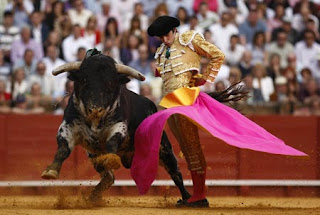
In these here United States it is difficult to find someone who does not have an opinion one way or the other when it comes to bullfighting. It is either a barbaric and cruel relic of a less civilized time or it is a beautiful art-form and sport that represents a distinct and significant culture. I’ll be more than happy to admit that I am a bit biased towards the latter though I cannot say this has always been the case. The very first time I went to a bull fight I found myself aghast at the brutal nature of the sport. My American sensibilities wanted to shout that this is animal cruelty and this is barbaric and this is obscene! But I was missing the point. That isn’t what bullfighting is about. There is an anecdote, I don’t know how true it is, where Orson Wells was at a dinner at Hearst’s Castle and described an occasion where he sat at the knee of famous Spanish matador, Manolete, and Hearst remarked,“It is barbaric. Of all of man’s sadisms, nothing is more depraved than his cruelty to animals.” Mr. Wells took umbrage and replied quite sharply, “In Spain, sir, the cruelty would be in denying the beast a fighting end. As in your magnificent zoo, for instance.” Point being that there is always more than one point of view.


Last time I went to a bullfight was back in 2004. I was in Spain, in Pamplona, for the Festival of San Fermin and during each day of the festival there are bullfights in the afternoon. There was one matador in particular who had everyone’s attention. I don’t remember his name or any details about him other than that he was a relative newcomer who was making quite a name for himself. Every evening four bullfighters would find themselves in the arena three or four times, each one vying for the adoration of the audience. Each flourish of the cape and confident stride in to harm’s way was an attempt to command the crowd as well as the beast. This particular young matador was all of 19 years old I believe, and perhaps he had such confidence because he had not been instilled with the fear that some of the more mature fighters might have.


His stylish propinquity to the animal, the bravado and showmanship, his very presence captivated the crowd, half of which was under the shade of the stands, the other baking in the hot July sun doing all they could to quell the heat with bottle after bottle of sangria. This young matador demonstrated his mastery over the animal, looking him dead in the eye every time the beast charged, its calamitous hooves shaking the earth beneath them. After the colored barbs and lances, the taunts and runs back and forth across the arena, the matador presented his sword, his estoca, to the adulation of the attendants all clothed in white and red and wine. You know the old Looney-Tunes episodes where Bugs Bunny is fighting a bull and you see the bull dig it one of its hooves into the dirt before it charges? That really happens! Prior to seeing it in real life I thought it was just a comedic exaggeration. But finally it comes to one last charge. I don’t even know how one practices for this- standing your ground in front of a charging, angry, 1600 pound beast with nothing left to lose. A flourish of the cape and the bull builds up speed, charging and thundering through the screams of the crowd, the glare of the matador, and weight of certain death. Stepping to the side, missing the bull’s horns by just inches, and with just a fraction of a turn his blade is gone, disappeared into the hulking neck of the beast. The bull, not knowing he is already dead, spins around and begins his charge again and with that the banderilleros and other toreros rush in to, shaking their capes to distract the animal and keep him from goring the bullfighter but he calmly waves them away. Coming to the austere realization of what has befallen him the bull slows down as he comes upon the matador. Their eyes meet and the bullfighter rests his palm on the beast’s forehead as it falls into sleep one final time.


This kid, whatever his name was, gave an equally impressive performance every time he had the floor. Rapturous applause engulfed the ring at his every appearance. He made the cover of the local newspaper and was shown on the evening telecast. It was pretty amazing and to me he seemed like the very incarnation of Pedro Romero from The Sun Also Rises.


So there is the anecdotal part. Now for some history and technical stuff that might be of interest: Bullfighting is found in many Spanish speaking countries like Spain, Mexico, Columbia, Venezuela, Peru, and Ecuador. It’s most direct early ancestor probably dates to the various games held in coliseums of ancient Rome. People vs people, people vs animals, animals vs animals… it all happened throughout the Roman Empire. Prior to that, pretty much ever since there was man and ever since there have been animals one has been killing the other- usually for food, sometimes for sport, and not uncommonly for sacrifice. There are cave paintings dating back to 200 years Before Christ that show a man facing a bull. Of course it was the Spanish who spread the sport to Central and South America and it was not uncommon for these games to take place at important events like weddings and funerals. According to Wikipedia, The modern style of Spanish bullfighting is credited to Juan Belmonte generally considered the greatest matador of all time. Belmonte introduced a daring and revolutionary style, in which he stayed within a few inches of the bull throughout the fight. Although extremely dangerous (Belmonte himself was gored on many occasions), his style is still seen by most matadors as the ideal to be emulated. Today, bullfighting remains similar to the way it was in 1726, when Francisco Romero, from Ronda, Spain, used the estoque, a sword, to kill the bull, and the muleta, a small cape used in the last stage of the fight.

One particular throwback to the gladiatorial days that still exists is that the bull has the chance to win his freedom. Though it is an extremely rare occurrence, if a bull is valiant and impressive enough, the matador will stand and look up at the President’s (or Governor’s) box. If he gets the indication from el Presidente to spare the animal’s life, the animal is taken from the ring and gets to live out the rest of his days in fields of green, put out to stud from time to time.

Of course as time has gone by and we have become more “civilized” the sport has fallen out of favor with a huge segment of the population. It is after all a pretty violent sport that ends with either the death of a gorgeous animal or the goring of a human being. So there are definitely protests and calls to end the practice in Spain. On one hand, up until the actual bull fight, the bull’s life is much less terrible than it would be in a commercial farm. On the other it is still a slow, torturous death with almost chance of freedom or survival. And for those of you who weren’t sure, yes- the bull from the fight is used for food. And yes again, it is delicious.


Whatever your stance, the one thing everyone can agree on is that it is a significant aspect of Latin-based culture, from Spain and France to North and South America. I’ve never had the chance to get to a bullfight in Mexico but it seems like it would be something worth checking out.

Wednesday, February 3, 2010

I'm Supposed to Appear Mexican

I’ve been told I don’t look Mexican.

I suppose I don’t carry many of the characteristics that come to mind when one thinks of the physical attributes of our cousins south of the border. Usually when one thinks “Mexican” one thinks of any of the following traits: tan skin, dark eyes and hair, probably on the shorter side, Mexicans are not known for being particularly thin or large when it comes to body types, and I could go on. As for myself, I have the dark eyes and hair but definitely not the tan skin. I’m not tall but not all that short. On the occasion we’d stop by the Calimax in Tijuana I felt like I could be on the Olympic basketball team. When people do take a stab at guess where my forefathers come from I typically get guess from the Mediterranean like Italian or Turkish or Israeli. I’ve gotten many countries from South America, the Caribbean and even the generic “white”.

Perhaps I don’t carry many of the stereotypical traits, I’m no Eric Estrada or Don Francisco, but then neither is Linda Carter (and Wonder Woman just happens to be half Mexican). I’ve touched on the many influences on Mexican people plenty of times before when it comes to food and celebration but not the physical traits of the people. What is a Mexican supposed to look like?

My closest friends, like me, are the children of Mexican immigrants. One of them has skin that, while not as light as mine, is still pretty fair. He’s 6’3”. The other is about my height but has reddish brown hair almost as red as his mother’s who also happens to have green eyes. Anyone remember that show Gilmore Girls? The girl who plays the daughter, Alexis Bledel, is a very fair skinned young woman has very very blue eyes. These are just a few examples of different Mexicans can appear. We could be that blond haired dude with the green eyes. We could be that guy with the dreadlocks who might be black (that’s actually my cousin Eddie). We could be in your kitchen right now!

So where do all these different looks come from? All over! Obviously there were the indigenous people who already lived what we call Mexico and the western United States all the way down through South America. These were different cultures with their own varied physical traits and aspects and are the reason I can barely grow facial hair today. Without getting in a big demographic and anthropological analysis I can say that these indigenous peoples greatly influenced the idea of what a prototypical Mexican is supposed to look like. Since it is Spanish that is mostly spoken in Mexico (each of the specific native groups still thriving in Mexico has their own language) we tend to only think of people from Spain who colonized the land. When they decided to go native, akin to John Rolfe and Pocahontas, we called their progeny “mestizos”. The word is derived from the Latin word for “mixed” but its use was synonymous with calling someone a bastard. The connotation of the word has changed since then and now simply refers to one who is of both European and native ancestry.

Even when we look at the Spanish we can clearly see that they do not look Mexican. For all intents and purposes they are white, Europeans. That just leads to more and more lines of ancestry as Spain was at various times dominated by Jews, Moors, Romans etc… A not uncommon Mexican last name is Delao (or De La O) which comes from the Irish who came to Mexico. There were Germans, Portuguese, and even Chinese who travelled south from San Francisco once the railroads were built. If America is a melting pot then Mexico is a thick soup. I like to think of it as a nice fondue set filled with nacho cheese.

Anyway, Mexicans clearly come in all shapes and sizes, shades and colors. We’re not just tan and exotic looking like Selma Hayek, we’re also svelte and fair like Alexis Bledel. But we can also be exactly what you think. Like Paul Rodriguez.