Monday, February 14, 2011

El Matador...


In these here United States it is difficult to find someone who does not have an opinion one way or the other when it comes to bullfighting. It is either a barbaric and cruel relic of a less civilized time or it is a beautiful art-form and sport that represents a distinct and significant culture. I’ll be more than happy to admit that I am a bit biased towards the latter though I cannot say this has always been the case. The very first time I went to a bull fight I found myself aghast at the brutal nature of the sport. My American sensibilities wanted to shout that this is animal cruelty and this is barbaric and this is obscene! But I was missing the point. That isn’t what bullfighting is about. There is an anecdote, I don’t know how true it is, where Orson Wells was at a dinner at Hearst’s Castle and described an occasion where he sat at the knee of famous Spanish matador, Manolete, and Hearst remarked,“It is barbaric. Of all of man’s sadisms, nothing is more depraved than his cruelty to animals.” Mr. Wells took umbrage and replied quite sharply, “In Spain, sir, the cruelty would be in denying the beast a fighting end. As in your magnificent zoo, for instance.” Point being that there is always more than one point of view.
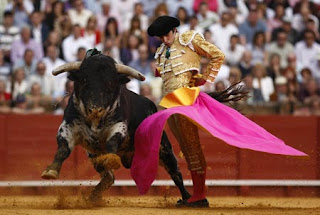

Last time I went to a bullfight was back in 2004. I was in Spain, in Pamplona, for the Festival of San Fermin and during each day of the festival there are bullfights in the afternoon. There was one matador in particular who had everyone’s attention. I don’t remember his name or any details about him other than that he was a relative newcomer who was making quite a name for himself. Every evening four bullfighters would find themselves in the arena three or four times, each one vying for the adoration of the audience. Each flourish of the cape and confident stride in to harm’s way was an attempt to command the crowd as well as the beast. This particular young matador was all of 19 years old I believe, and perhaps he had such confidence because he had not been instilled with the fear that some of the more mature fighters might have.


His stylish propinquity to the animal, the bravado and showmanship, his very presence captivated the crowd, half of which was under the shade of the stands, the other baking in the hot July sun doing all they could to quell the heat with bottle after bottle of sangria. This young matador demonstrated his mastery over the animal, looking him dead in the eye every time the beast charged, its calamitous hooves shaking the earth beneath them. After the colored barbs and lances, the taunts and runs back and forth across the arena, the matador presented his sword, his estoca, to the adulation of the attendants all clothed in white and red and wine. You know the old Looney-Tunes episodes where Bugs Bunny is fighting a bull and you see the bull dig it one of its hooves into the dirt before it charges? That really happens! Prior to seeing it in real life I thought it was just a comedic exaggeration. But finally it comes to one last charge. I don’t even know how one practices for this- standing your ground in front of a charging, angry, 1600 pound beast with nothing left to lose. A flourish of the cape and the bull builds up speed, charging and thundering through the screams of the crowd, the glare of the matador, and weight of certain death. Stepping to the side, missing the bull’s horns by just inches, and with just a fraction of a turn his blade is gone, disappeared into the hulking neck of the beast. The bull, not knowing he is already dead, spins around and begins his charge again and with that the banderilleros and other toreros rush in to, shaking their capes to distract the animal and keep him from goring the bullfighter but he calmly waves them away. Coming to the austere realization of what has befallen him the bull slows down as he comes upon the matador. Their eyes meet and the bullfighter rests his palm on the beast’s forehead as it falls into sleep one final time.


This kid, whatever his name was, gave an equally impressive performance every time he had the floor. Rapturous applause engulfed the ring at his every appearance. He made the cover of the local newspaper and was shown on the evening telecast. It was pretty amazing and to me he seemed like the very incarnation of Pedro Romero from The Sun Also Rises.


So there is the anecdotal part. Now for some history and technical stuff that might be of interest: Bullfighting is found in many Spanish speaking countries like Spain, Mexico, Columbia, Venezuela, Peru, and Ecuador. It’s most direct early ancestor probably dates to the various games held in coliseums of ancient Rome. People vs people, people vs animals, animals vs animals… it all happened throughout the Roman Empire. Prior to that, pretty much ever since there was man and ever since there have been animals one has been killing the other- usually for food, sometimes for sport, and not uncommonly for sacrifice. There are cave paintings dating back to 200 years Before Christ that show a man facing a bull. Of course it was the Spanish who spread the sport to Central and South America and it was not uncommon for these games to take place at important events like weddings and funerals. According to Wikipedia, The modern style of Spanish bullfighting is credited to Juan Belmonte generally considered the greatest matador of all time. Belmonte introduced a daring and revolutionary style, in which he stayed within a few inches of the bull throughout the fight. Although extremely dangerous (Belmonte himself was gored on many occasions), his style is still seen by most matadors as the ideal to be emulated. Today, bullfighting remains similar to the way it was in 1726, when Francisco Romero, from Ronda, Spain, used the estoque, a sword, to kill the bull, and the muleta, a small cape used in the last stage of the fight.

One particular throwback to the gladiatorial days that still exists is that the bull has the chance to win his freedom. Though it is an extremely rare occurrence, if a bull is valiant and impressive enough, the matador will stand and look up at the President’s (or Governor’s) box. If he gets the indication from el Presidente to spare the animal’s life, the animal is taken from the ring and gets to live out the rest of his days in fields of green, put out to stud from time to time.

Of course as time has gone by and we have become more “civilized” the sport has fallen out of favor with a huge segment of the population. It is after all a pretty violent sport that ends with either the death of a gorgeous animal or the goring of a human being. So there are definitely protests and calls to end the practice in Spain. On one hand, up until the actual bull fight, the bull’s life is much less terrible than it would be in a commercial farm. On the other it is still a slow, torturous death with almost chance of freedom or survival. And for those of you who weren’t sure, yes- the bull from the fight is used for food. And yes again, it is delicious.


Whatever your stance, the one thing everyone can agree on is that it is a significant aspect of Latin-based culture, from Spain and France to North and South America. I’ve never had the chance to get to a bullfight in Mexico but it seems like it would be something worth checking out.

Monday, August 9, 2010

Donde?

Just a reminder that, thanks to all of you glorious supposed Mexicans who give this corner of the internet a look every now and then, entries from this blog have been posted on various websites including:

http://www.hispanicla.com/

http://www.bilingualbraings.com/

and most recently - http://www.labeez.com/

Thanks for reading and check out these other sites because they have some interesting stuff.

-EricV123

Sunday, August 8, 2010

Novelas: TV for Audiences who can be Satisfied

My grandmother would usually pick up my brother and I from school every afternoon. We were kids and in all probability annoying as hell but she pretty much gave us run of the house- baseball in the back yard, board games in the patio, action figures and toy cars… We seldom got in to trouble but when we did she certainly reminded us who was in charge. All afternoon she even gave us control of the TV. But that ended as soon as evening came and it was time for the novelas. My aunt would stop by. Mom would be over to pick us up after a long day of work. But before we left they had a cup of coffee and maybe some pan dulce and stopped to see something that could not be found on American television.

For a nation that is relatively wasteful in so many ways, we are sure to squeeze every last bit of value out of out entertainment. Some stick, like the 20+ James Bond movies out there. Some, like the last couple of seasons of Friends, hang around perhaps a bit longer than their sell-by date. And still others run the gamut until they become a parody of their origin; shows like The Real World and its spin-offs, or The Bachelore(tte). This is not the case with the telenovelas (novelas for short) that one will find on Univision or Telemundo. Though there have been some attempts to adopt the model for American audiences it is extremely difficult for consumers and providers to walk away from a hit show.

Here is how novelas work: by definition they are on a limited run, usually lasting less than a year. That might seem like just any old mini-series you’ve seen anywhere but the content differentiates the genre from that of a typical min-series. Novelas are always convoluted love stories with twists and turns in the plot. Generally you will see a couple kissing in the first few minutes of the program and something will happen to drive them apart. 120 episodes later they will be kissing again in the final scene. So you won’t find epic wars fought as in Battlestar Galactica, nor will you find stories of brotherhood as in Band of Brothers. The content is completely relegated to the soap opera type of plots with steamy love scenes and tales of lust and revenge. Again, unlike a typical soap opera there is a designated end planned from the very beginning. They can be period pieces or take place in a contemporary setting but the one thing you can count on is that it will end. You may fall in love with the characters and demand more but that simply isn’t the way these work.

American studios have tried to emulate the model of the novela on various occasions but the results have been rather disastrous. A small television unit called MyNetworkTV tried to use the format but interest fell off quickly after their first season. That may be because audiences weren’t interested in investing their time in something they knew would be over in a matter of months, or it could be because the shows simply weren’t any good. It takes an act of God and a bolt of lightning for a show to have a successful run even if it has major star power and a great time slot. Anyone remember the Cosby Mysteries? Or that one show Michael Richards had after Seinfeld? Whatever the case, the American attempts could not copy the success of their Latino counterparts.

This isn’t to say that the genre has not had a profound influence on American television. While shows like 90210 and Melrose Place were essentially prime time soap operas with characters whose histories the audience followed no matter how outlandish the plot might be, prior to the early 90s I am hard pressed to think of many shows with a season long story arch. Sitcoms like Three’s Company or Cheers were essentially stand alone half hour shows that could be plugged into the season in any order. Occasionally there were two-parters or very special episodes that would have some lasting effect that might be referred to in a later episode. But there wasn’t really a sense of the show being mapped out for the season with a specific goal that the audience is searching for. Moonlighting had the basic premise of a guy and a girl who should be together but were not… And audiences watched it in hopes that they would finally get together, not because they knew that’s what was supposed to happen at the end of season 2. Fast forward to the early 2000s to the appearance of Heroes, Desperate Housewives and 24. Both of these shows had a very specific story arch that would find a conclusion at the end of the season while setting up events for the season that followed. Audiences were captivated by the notion that their time spent in viewership would be rewarded with a conclusion to the story. Had any of these shows simply ended after their first season they would be regarded as culturally significant events that captivated a nation. Instead they are being milked for all they’re worth and have fallen into mediocrity, a step away from oblivion. Ugly Betty was originally supposed to be ABC’s attempt at an American novela but they decided they would rather ride it out until it eventually got cancelled due to dwindling ratings. Twice.

Like soccer, I’m not entirely sure why novelas won’t catch on in America. I guess it’s the same reason we have a fourth Indiana Jones movie and those last three Star Wars abortions. If we can squeeze a few more bucks out of a character, we probably will line up to see it. By the way, let me know how The Real Housewives of DC turns out.

Friday, August 6, 2010

King Taco

I don’t have the same tolerance for spicy foods that my father does. When he wants salsa he wants it so hot he is sweating by the time he gets through his meal. And then he wants a little bit more. I don’t like to need a towel to wipe my brow at the end of a meal but I like a little bit of kick and when I ask for something I want it spicy for real, not white-people spicy. Not Cheesecake Factory we-added-some-extra-black-pepper-and-a-touch-of-cayanne-pepper-spicy but something that is going to burn a little bit and will be made worse if you try to wash it away with water. You can get this at King Taco. You can get the spiciness my dad prefers but if you don’t want the burning depth of hell raging in your mouth you can get a decent kick as well. A good salsa makes all the difference in Mexican food. You could have the sweetest corn cakes, the most savory tamales, or the crispiest chips, but if you don’t have a spicy salsa then you are eating at El Torito or, if they’re still around, Alcapulco’s.

King Taco is on my list of musts every time I get back to Los Angeles, which is a few times per year. My family has been a loyal customer since my childhood. After visiting cousins or extended family, friends, after YMCA youth softball games or sometimes after an early Dodger game, stopping by King Taco- the one on Cypress or maybe the one on Third, depending on where we were coming from, was on the itinerary. Over the years as the brand expanded it got easier and easier to find one, much to my delight. Now they even have a spot in Dodger stadium and that pretty much rocks.

King Taco got its start back in 1969. Raul Martinez and his wife, Maria, lit the barbeque at the park (I’m guessing Leg Lake but that information wasn’t available), a bunch of guys playing soccer nearby finished up and passed by to see what smelled so good. They bought a bunch of tacos and BOOM! A legend was created. Five years later Raul and Maria bought an old ice-cream truck and converted it into a taco truck, an innovation that I think we all take for granted these days. Knowing their audience, Raul, Maria, and Raul father, parked the taco truck outside of a bar one night and had about $70 worth of sales. The next night they doubled that. Six months later the first King Taco restaurant with a permanent address opened at 1118 Cypress Ave. in Los Angeles. The rest is history and with just 21 locations from Commerce to Ontario everyone knows if you want a good taco you go to King Taco.

Part of the appeal is the value. Tacos are just a $1.25 and there is quite a variety to choose from. You can go with the simplicity and ease of carne asada, carnitas, or pollo, but for the real Mexicans, the ones who aren’t just supposed to be Mexican but actually know the Mexican National Anthem (I still have to learn that one), they offer lengua, cabeza, buche, and mollejo. I’d love to just tell those of you who don’t speak Spanish exactly what those are but part of the fun is figuring that out if it’s your first visit. I couldn’t in good conscience, ruin for you but I will say it might seem kind of rowdy if you aren’t terribly familiar with Mexican cuisine.

I may be confusing King Taco with Olvera street from my youth but I thought they used to feature Fanta and/or Orange Bang (along with Piña and Lemon Ole!) but they don’t seem to be on the menu anymore. They do, however, still serve aguas frescas which sounds very good during these summer months. Other menu items include tameles, sopes, and chicken but you go for the tacos. Just like even though Lawry’s Prime Rib has lobster, it’s not what you go there for. With King Taco you go for the tacos.

I won’t be making my way to Southern California for at least another couple of months but already my mouth is watering for some of those delicious tacos. So many nights heading back from Hollywood or wherever and taking an exit off the 60 freeway to pull up to the brightly lit sign with shaved heads and Dickies in front of low-riders on one side and LAPD or LA County Sheriffs on the other side. It’s a good mix. Oh, and if you are heading east on the 60, make sure you hit the right exit because if you can see it from the freeway then you’ve gone too far and you’ll have to back track.

Thursday, June 17, 2010

The Mission


Like any well mannered young person moving to a new city to attend college, my priorities in my new home in San Francisco were as such: find a place to live, find a place to get food, and most importantly, find a place for cheap beer. Within the city limits of San Francisco that last requirement is found by so many dedicated students in the Mission District. Nestled pretty close to the center of the city, the Mission sits surrounded by SoMa to the west, Bernal Heights to the south, and the Castro to the east. For such a small city it has always been incredible to me how it can sustain so many distinct neighborhoods with their unique characteristics. Even the most aloof resident of the city (and there are many) can tell what part of the city they are in by the architecture, the shops and restaurants, the bars and attractions, the geography. The Sunset is not Twin Peaks. Pac Heights is not the Presidio. You try to stay away from Hunters Point. And still no one exactly knows where Excelsior is. When it comes to the Mission you will know you’re there by a few distinct traits beyond the cheap beer: due the geography of the city it is probably the warmest and sunniest part of the city; there are two BART (subway) stops; and it is the largest Latino community in the city.

The area has had a Spanish influence since 1776 when Spanish priest Francisco Palou founded the Mission for which the city is named- after St. Francisco de Assisi. Prior to that the area had been inhabited by the Yeluma Indians for over 2000 years but as everyone knows, whenever you mix Europeans and natives… one of them is going to disappear and it will probably the ones who haven’t been making use of gun powder for 1000 years. The Mission that currently stands was built in 1783, probably with forced Indian slave labor. The surrounding area with owned by various Spanish rancheros with names that are still important to the city of San Francisco like Valencia, Bernal, Noe, Guerrero- these are currently names of streets and neighborhoods throughout the city. Eventually the land was ceded in the deal that ended the Mexican-American War. The Gold Rush came and went and along with the rest of the city, the Mission District grew economically by leaps and bounds; it was home to California’s very first professional baseball stadium and had a couple of others over the following century which were home to teams like the San Francisco Seals and the Mission Reds.
Throughout most of the 19th and well into the 20th century, the Mission was mainly a German and Irish community. After the earthquake of 1906 so much of the city’s economic and commercial center in the downtown and financial districts had been destroyed or disrupted that the Mission became the main commercial thoroughfare for a short time. The area saw an influx of Polish immigrants as well but like so many other places, once World War II arrived everything changed.

When so many men left to join the war effort, their families returned to their families or simply moved on. As such this left a void in the housing market and prices and populations dropped. Enter a new group of immigrants, the Mexicans. The Germans, Irish, and Poles had left and the Mexicans seized the opportunity for inexpensive housing. This started happening in the 40s and went well into the 60s and the neighborhood has been a Hispanic community ever since. In the 1980s, civil unrest and instability in the Central America brought many more immigrants to these here United States and many of them reside in the Mission District which is why their Mexican food is substantially subpar when compared to Southern California efforts, but it is probably the best place to get a plate of pupusas.

Over the past decade or so, since it has become the trend for young urban white people to gentrify neighborhoods because it’s “more real” (see Brooklyn; see Oakland; see Echo Park), the Mission has seen a dramatic increase in the white population along with increased housing prices- even Dave Eggers’ charitable foundation, 826 Valencia, is based there. Despite this, the district remains a destination for Hispanic immigrants.

A few things to see and do whilst in the Mission include a visit to actual mission which still stands on Dolores Street, not far from Dolores Park. My favorite rock climbing gym, Mission Cliffs is there. And the Mission is home to many Latino art galleries and cultural centers like Galeria de la Raza, and so many murals all over the neighborhood that were commissioned by the Chicano Art Mural Movement of the 1970s. The Mission has become synonymous with great burritos, too. In fact, there is a restaurant not far from my place in Upper West Side Manhattan that boasts “San Francisco Mission Style Burritos”. Mission and Valencia streets are home to dozens upon dozens of bars, bookstores and restaurants that are host to the annually literary event LitQuake in October. It was home to a punk scene for a while and was even characterized as a Bohemian community akin to Greenwich Village though it’s difficult for any neighborhood close to Haight and Ashbury to co-opt that moniker.

So the Mission isn’t exactly a Mexican neighborhood anymore but it does have strong Mexican ties and a rich heritage. One of the drawbacks to San Francisco’s fantastic BART system is that it ceases to run by 1:00am on the weekends. With the bars going until 2:00am this can cause a crisis of priority. Countless times I’ve found myself enjoying a cold beverage with friends as single tolling of a bell drew near. One more, my friends would say- and I would relent. Then, with just moments to make the last train, I’d run out of Zeitgeist or the Latin-American Club or the Elbo Room, as fast as I could. Half the time I made it, saving myself a $25 cab ride home. The other half of the time my comrades would smile as I walked back into the bar with a bacon wrapped hot dog in my hands as I’d sit down to another beer.

Wednesday, June 9, 2010

The Crying Woman

As you stroll along the lakeside you listen to the gentle lapping of the water on the shore. The moon glows in a blood-orange hue just above the horizon as dusk falls over you. In the distance fireflies bounce and bob over the tall grasses that peek out along the waterfront. The ground is moist beneath your feet and the soil softens beneath your every step as you walk along, admiring the moon’s reflection over the lake, the chirping of the crickets, and the occasional call of an owl. But then something seems off. You suddenly feel warm over one side of your neck and you look over your shoulder; it’s the unmistakable sensation of the invisible pressure of someone else’s gaze falling upon you. You know you’re being watched. The speed of your steps increases. More than just speeding up, a draft washes over you, blowing against you, trying to push you back but you press on. You’re almost running now and it’s at this point that you realize you only hear the crunch of the grass and soil beneath your feet. No more chirping crickets. No more hooting owls. The water is completely still as you come to a standstill. Where did the fireflies go? All you hear is your own breathing coming in shaking, stammering, gulps. Then you hear something else. It could be your mind playing tricks on you but you hold your breath to make sure. It starts off like a moaning but that’s only because it sounds muffled, off in the distance. You want to run but you don’t know where the sound is coming from and it’s impossible to tell if you’d be running towards it or away from it. The moaning gets louder but it isn’t just moaning. The pain is the same but it is something more. Wailing. Weeping. As though the world around you is crying for something that’s happened. Or. Something that’s about to happen. Something that cannot be stopped or prevented. It’s the crying of a woman who has lost everything. Soon the crying is everywhere- it’s upon you. And it’s the last thing you hear…

La Llorona is a cautionary tale told throughout Latin America. Think of it as the Sleepy Hollow story of the Spanish speaking world.

There are many different versions of the story but the bare bones of it is this: There was a woman who killed her own children to be with the man she desired. She was subsequently spurned by her lover and as a result she killed herself. However, because of her atrocities she is forced to wander (usually near a body of water), weeping for what she had done, weeping for her lost children and looking to replace them. She is looking for her children and will often take children who misbehave or wander off.

Needless to say it has scared the hell out of many, many children.

It is difficult to say exactly where this story originated as there are examples of similar tales all over the world. Among the ancient Greek gods, the big guy, Zeus, had an affair with Lamia. When Hera, Zeus’ wife, learned of the affair she forced him to give up his relationship to Lamia who was then forced to eat her own children. Out of jealousy, Lamia preys on human children and eats any that she catches. The Greeks have some pretty messed up stories. Other variations of La Llorona’s story say that those who hear her weeping are marked for death, not unlike those who hear the wailing of the Gaelic Banshee. Other possible origins of the story point to the Spanish invasion of the Aztec empire. Some say the goddess Cihuacoatl is weeping for the fall of her people. Others point to La Malinche, a native woman who served as an interpreter for Cortes and turned her back on Mexico. Though there is no hard evidence to support it, some say she bore the conquistador a child and was later abandonded.

An interesting website that provides more detailed aspects of the current legend of La Llorona can be found at www.lallorona.com/la_index.html. It tells different stories of La Llorona as a witch, a harlot, a siren, and a virgin. They get a little creepy so don’t read them late at night by yourself.

As for why the story exists, like most stories it is probably a cautionary tale. On one level it is meant to keep children from wandering off. Like the boogey man or Michael Jackson, these characters are meant to frighten children and keep them away from strangers. It is also a warning for young women to either avoid being enticed by the wrong man, or to remember the sacred duties of a mother. Pre-Columbian women had a lot more power and influence than their conquered descendants. The European conquerors did not have the same idea of the sacred feminine that the indigenous peoples of the Americas had and as such did many things to destroy their ideas of the role women should have in society. That’s just the way it went and the story of La Llorona, a woman who is forced to an eternity of misery because of her failure as a wife and mother, may have been a part of that.

Whatever the origin of the story, it is a scary one. It’s certainly enough incentive to keep it in your pants a little while longer. Because if you’re getting down to it and the woman starts weeping… well, I can’t imagine any good will come of that.

Tuesday, June 1, 2010

So What's Up With This Arizona Law?

One of the big issues concerning Mexican Americans lately is the passage of the immigration reform law in Arizona. Needless to say plenty of people having been asking EricV123 just what he thinks of the law and what it means to Mexicans on this side of the border both here legally and illegally. Now, I do not want to make this a political blog, nor do I wish to advocate one side over the other but to ignore the subject all together would be an egregious oversight on my part.
So let’s examine what the argument it. The text of the law, in its entirety, can be found here: http://www.azleg.gov/legtext/49leg/2r/bills/sb1070s.pdf. It’s only about 17 pages and half of that is filled with superfluous language. The gist of it is this: if police are stopping someone for a crime or violation of the law, this could be an infraction, misdemeanor, or worse, if after detaining someone for committing an offense then if the officer suspects the person of being in the country illegally the officer may and shall demand proof of legal residence which should be carried on the person. The law clearly states that race must not be the sole consideration.


Sounds fine, right? I mean, after all, the innocent have nothing to fear, am I right?


Except that they do. Now I’ve got pretty fair skin and speak English with no discernable Mexican accent. But I’ve got some friends and family who have darker skin than I do and speak with a different cadence, say words with a different inflection that makes their English sound a little more Mexican. Say one of these people was to suddenly have a craving for a delicious, cool, refreshing bottle of Gatorade on a hot Arizona day. It’s 105 degrees out and they’ve been sitting around in their shorts all day. The 7-11 is just two blocks away so our friend grabs a five dollar bill off the counter and shoves it in his pocket and jumps on his bicycle to pedal just a few hundred yards away. On the way he slows at the intersection and when he doesn’t see any cars in either direction he scoots across, just like he’s done a million times before, just like you me, or anyone has ever done. Whether the light is red or green, especially here in New York or in every suburb across America, when there aren’t any cars around you just go. But this time there is a cop sitting behind the billboard so he jumps out to write up a ticket. No ID, no wallet, just a $5 bill in your pocket… you’ve got dark skin and use a different syntax in your English that he does… now the cop wants to see your green card. But you’re a citizen, you tell him. You live right down the street. Oh yeah? Prove it. Maybe the cop happens to be having a good day and is nice enough to drive you over to your house and knock on the door- but you already told him no one is home. And he is not about to enter a house without cause on the word of a suspected illegal alien. So guess what, we’ll just take you to jail until we can sort this thing out. Maybe a few hours, maybe a couple of days later you get to go home. Sorry for the inconvenience, sir. Have a nice day.

This sort of anecdotal story has already happened to friends of friends and is likely to happen more often in the weeks to come… But racial profiling is against the rules according to the law. And the policeman wasn’t racially profiling but had a suspicion after he saw the young man riding his bike across an intersection on a red light.

Here’s the problem- the letter of the law seemingly has no racial prejudice. The letter of the law says nothing about skin color or national origin. Theoretically if a British tourist crosses the street having left his passport in the hotel he could very well be deported. But let’s all be honest with ourselves, the spirit of the law is targeting Mexican immigrants. The law is intended to root out Mexicans who may be here illegally- and even that I don’t have to big a problem with. I would prefer that people who were here illegally were given greater opportunity to integrate fully and become either legal residents or American citizens because for the most of these people, their crime is not being able to wait long enough or have enough money to bribe a corrupt government (Mexico’s) and so they came looking for a better life and greater opportunity. But I’m realistic. The means and the structure to welcome people in droves- the way we did at Ellis Island so many years ago, just doesn’t exist.

No, for me the problem is that this law forces law abiding, tax-paying, hard working citizens, to be treated as second class citizens because of how they look or speak. Sure the law says race alone cannot be the only consideration but it stipulates the use of “reasonable suspicion” which is entirely up to the officer. The law does not specify what “reasonable suspicion” entails. So if someone who looks or sounds different happens to forget her purse at work, leaves his wallet at the gym, and crosses the street at the wrong place… he or she is shit out of luck until they can prove they have the right to be here. Any officer will tell you (especially Highway Patrol), if watch someone long enough, probably just a few minutes, there will probably have a reason to pull them over. Police officers have a very unique power. They have the power to remove someone’s freedom. We grant them this power to do their job effectively along with several other powers. When someone if breaking the law we expect our police force to act accordingly. Is detaining for several days a guy going to the corner store without his wallet an appropriate use of that power? Especially if he actually is a US citizen?

This is different from wire-taps on people who are communicating with known terror connections. This is different from racial profiling at the airport because face it, we get more people trying to blow stuff up from certain countries in the middle east than we do from Switzerland. In those cases there is an immediate danger of the wanton killing of innocent people. Arizonans have every right to secure their international border when the Federal government fails to do so. And they should. And when someone commits a crime, not spitting your gum out into the gutter or jay-walking, but a real crime, and it turns out the person is here illegally, then, by all means deport his ass.

But forcing our American Citizens to “carry papers” at all times is just as morally reprehensible to the internment of our Japanese citizens during World War 2.

Many Jim Crow laws said nothing about race. Saying you have to pass a reading test to vote, that doesn’t say anything about race. Saying you are exempt from those types of tests if your grandfather could vote… nothing about race there either.
EricV123 says, let’s stop playing verbal gymnastics and getting into semantic arguments when we all know that this law violates the liberties of American citizens on the perceived basis of national origin and that is simply, plainly, totally, wrong.